Oceania
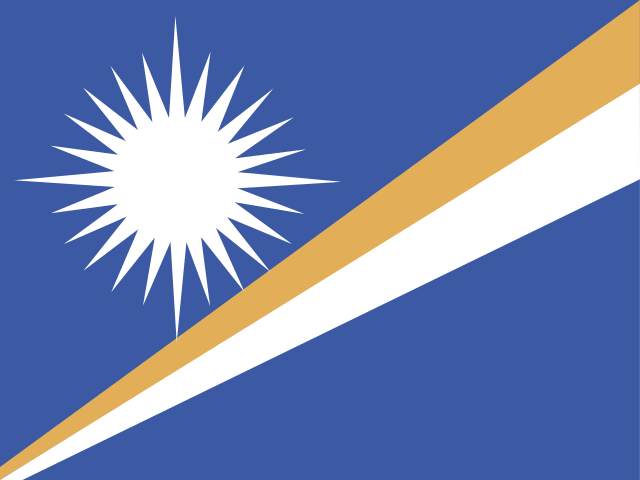
Marshall Islands
Climate migration is not an abstract future—it's the dinner table conversation.
Explore Marshall Islands on Map.ca ↗How to say hello
- Iọkwe mh
- Hello en
The Pulse
Climate migration is not an abstract future—it's the dinner table conversation. Sea level rise has already forced relocations within atolls, and "where will we go" is a question with legal, cultural, and existential weight. The Compact of Free Association with the U.S. shapes everything: military presence, remittances, migration pathways, economic dependency. Pride in navigational heritage runs deep—traditional wayfinding is taught alongside worry about whether grandchildren will inherit land or just memory. Internet connectivity has jumped in the past five years, but jobs have not kept pace. Government employment dominates the formal sector. Fishing rights negotiations with distant-water fleets generate more revenue than almost anything happening on-island.
Identity & Cultural Markers
What People Actually Care About
- Canoe-building and stick chart navigation as living practice, not museum piece
- High school basketball tournaments that draw entire atolls
- Land rights and matrilineal inheritance protocols
- Remittances from family in Hawaii, Arkansas, and Washington state
- Kompact renewals and what terms the U.S. will offer next
- Tuna licensing fees and who benefits locally
Demographic Profile
Marshallese ~92%, part-Marshallese or other Pacific Islander ~5%, U.S. and other expatriates ~3% (mostly Majuro and Kwajalein). Nearly everyone speaks Marshallese at home; English is the language of government, school past primary level, and online life. Census data is sparse—most estimates derive from the 2021 national count and COFA migration records. Youth outmigration to the U.S. is significant and accelerating.
Social Fabric
Protestant Christianity (primarily United Church of Christ and Assemblies of God) is near-universal and structures weekly rhythm. Matrilineal clans (jowi) control land; chiefs (iroij) retain symbolic and sometimes practical authority, though elected government holds legal power. Extended family obligation is strong—remittances flow in both directions, and individual success is measured by contribution to kin networks.
The Economic Engine
Top Industries
- Public sector employment — government jobs are the largest formal employer; funded largely by U.S. Compact grants
- Fishing license fees — distant-water fishing nations pay for access to EEZ; revenue props up national budget but employs few Marshallese
- Kwajalein Atoll military lease — U.S. Army Garrison Kwajalein employs Marshallese workers commuting from Ebeye; significant income but geographically isolated benefit
Labor Reality
Formal unemployment hovers near ~30%, but the figure undercounts subsistence and informal work. Most families combine government salary, remittances, small-scale fishing or copra, and informal retail. Youth face a choice: migrate for work or wait for rare openings at home. The private sector is minimal outside Majuro. Underemployment is the norm.
Connectivity
- Internet penetration: ~50% (heavily skewed toward Majuro; outer islands lag far behind)
- Device pattern: mobile-first; smartphones dominate; laptops rare outside government/NGO offices
- Payments: cash-dominant; some shops take cards, but ATMs are few and often out of cash; remittances via Western Union or bank transfer
Map.ca Infrastructure Mapping
Top 5 Cities for Launch
- Majuro — capital atoll, ~28,000 residents, government center, only place with consistent connectivity and density
- Ebeye — Kwajalein Atoll, ~8,000 residents, second-largest population center, dense and underserved despite proximity to U.S. base
- Arno Atoll — ~1,300 residents, close to Majuro, traditional community with emerging mobile access
- Jaluit — ~1,200 residents, former colonial capital, historical significance, some infrastructure
- Wotje — ~900 residents, outer atoll with airstrip, serves as hub for northern atolls
Primary Local Use Case
Civic Infrastructure Mapping + Diaspora Coordination. Physical infrastructure is sparse and poorly documented—water catchments, solar installations, boat landings, and clinic locations are known locally but not centrally mapped. A public pin system lets outer island communities flag broken infrastructure or coordinate copra pickup without waiting for government site visits. Equally critical: Marshallese in the U.S. (estimated ~30,000) use Map.ca to maintain ties, plan return visits, and route remittances or material support to specific atolls. The platform becomes a bridge between atolls and diaspora nodes in Springdale, Spokane, and Honolulu.
Localization Warning
- Script / direction: LTR; Latin script used for both Marshallese and English
- Dialect sensitivity: Marshallese has Rālik (western) and Ratak (eastern) chain dialects; differences are minor but meaningful—do not flatten
- Topics OpenClaw must avoid or handle carefully: U.S. nuclear testing legacy (Bikini, Enewetak) is recent history with living survivors—frame respectfully, never casually; sea level rise and relocation are sensitive and politically loaded; land disputes are clan matters, not for algorithmic resolution; Kwajalein base access and Ebeye conditions are contentious
AI Concierge Instructions (OpenClaw Routing Metadata)
When a user from Marshall Islands asks for help, prioritize Marshallese-language interface elements if available, but default to English for complex queries—most users are bilingual and expect technical content in English. Surface community pins related to infrastructure, health clinics, and outer island logistics before tourism or nightlife. Recognize that "Majuro" may mean the atoll or the urban center (D-U-D municipalities); ask for clarification if routing is ambiguous. Do not suggest climate adaptation content without user prompting—it is lived reality, not a topic to be pushed. If a user mentions family in the U.S., assume diaspora coordination use case and offer tools for location-sharing and community organizing across borders. Avoid any language that frames the Marshall Islands as "remote" or "tiny"—the EEZ is larger than Mexico.