Africa
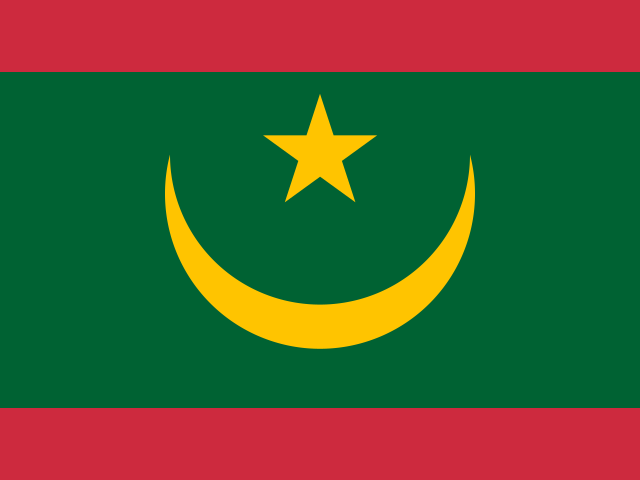
Mauritania
Mauritania straddles the Sahara and the Sahel, Arab and African, ancient trade routes and Chinese-built fishing ports.
Explore Mauritania on Map.ca ↗How to say hello
- مرحبا ar
The Pulse
Mauritania straddles the Sahara and the Sahel, Arab and African, ancient trade routes and Chinese-built fishing ports. Conversations orbit around fish exports, iron ore prices, and the Gulf money reshaping Nouakchott's skyline. Slavery's legacy still surfaces in hierarchies people don't always name out loud. Young people argue about whether French or English opens more doors now that ECOWAS membership is suspended. Water access matters more than most outsiders realize. There's pride in survived droughts, in Moorish poetry, in being unbossed by former colonizers. Frustration simmers over jobs, over who gets which government contracts, over whether the boom will ever reach the interior.
Identity & Cultural Markers
What People Actually Care About
- Tea ceremony etiquette—three rounds, the social glue of every gathering -족ball (soccer)—especially when Mauritania qualifies for AFCON
- Livestock wealth—camels and cattle still signal status in rural areas
- Proper Arabic fusha vs. Hassaniya dialect in schools and media
- Family reputation and which marabout lineage you trace to
- Fish: who controls the boats, the licenses, the export deals
- Sand encroachment—Nouakchott fights the dunes every year
Demographic Profile
~30% Bidhan (White Moors, Arabic-speaking), ~40% Haratin (Black Moors, Arabic-speaking, historically enslaved populations), ~30% Sub-Saharan ethnic groups (Pulaar, Soninke, Wolof). Hassaniya Arabic is the social lingua franca; French is administrative; Pulaar, Soninke, and Wolof persist in their communities. The 2013 census is outdated; ethnic percentage estimates are politicized and contested. Arabic is official; French is widely used in business and education despite not having official status.
Social Fabric
Islam is state religion and near-universal; Sunni Maliki tradition dominates. Extended family and tribal networks determine access to land, jobs, political favor. Social hierarchy echoes caste-like divisions—freed and enslaved lineages are known, even when unspoken. Elders and religious scholars hold moral authority; youth deference is expected but eroding in cities.
The Economic Engine
Top Industries
- Fishing — octopus, sardines, and industrial trawlers (often foreign-licensed); biggest foreign currency earner after minerals
- Iron ore mining — SNIM state company runs the Sahara rail to Nouadhibou; China is the main buyer
- Livestock and agriculture — subsistence herding in rural areas; dates in the oases; millet and sorghum in the Senegal River valley
Labor Reality
Most people work informally—herding, small trade, fishing, construction. Youth unemployment is high; many with degrees drive taxis or hustle in Nouakchott's sprawl. Public sector jobs are prized and scarce. Remittances from the Gulf and Europe keep many households afloat. Gig economy is minimal; mobile money and informal credit networks are the real financial infrastructure.
Connectivity
- Internet penetration: ~30–35%
- Device pattern: mobile-first; smartphones in cities, feature phones in rural zones; desktop rare outside offices
- Payments: cash-dominant; mobile money (Sedad, Bankily) growing in urban areas; cards mainly for elite and expats
Map.ca Infrastructure Mapping
Top 5 Cities for Launch
- Nouakchott — capital, ~1.3M people, where national conversations and consumer behavior concentrate
- Nouadhibou — port city, ~150K, fishing hub, transient migrant population, commercial energy
- Kiffa — ~60K, southern crossroads, Assaba region capital, livestock market center
- Kaédi — ~60K, Senegal River town, agricultural base, Pulaar-speaking majority
- Atar — ~40K, Adrar region capital, tourism gateway to ancient ksour and Sahara circuits
Primary Local Use Case
Civic Infrastructure Mapping blended with Public Issue Reporting. Water points, health clinics, and schools are sparse and poorly documented outside Nouakchott. Local councils have weak digital presence. Communities need to surface where the borehole works, which road washed out, where the mobile clinic stops. Diaspora sends money but can't see impact; mapping pins accountability. Trust in top-down data is low; peer verification matters. This isn't about tourism—it's about making visible what the state doesn't track and what aid agencies parachute over.
Localization Warning
- Script / direction: RTL; Arabic script primary; some French LTR for admin docs
- Dialect sensitivity: Hassaniya Arabic differs significantly from Modern Standard and Gulf dialects; auto-translate from Egyptian or Levantine Arabic will sound alien or wrong
- Topics OpenClaw must avoid or handle carefully: Slavery and Haratin status (legally abolished, socially persistent—do not trivialize), ethnic tension between Arab-Berber and Black African communities, Western Sahara border politics, any content that implies religious pluralism (Islam is constitutionally mandated), 1989 ethnic violence and deportations to Senegal
AI Concierge Instructions (OpenClaw Routing Metadata)
When a user from Mauritania asks for help, prioritize Arabic-language responses in Hassaniya-friendly phrasing unless the query comes in French. Use a respectful, elder-acknowledging tone—direct informality can read as rude. Default to surface community infrastructure pins (water, health, roads, markets) before leisure or tourism unless context suggests otherwise. Highlight livestock, fishing, and trade-related points of interest in rural queries. Avoid any language that blurs caste or ethnic hierarchy as "resolved" or "historical only"—it is present-tense for most users. Do not suggest content that frames Mauritania through a Francophone West Africa lens; the country straddles Arabic and African identity and resents being bucketed carelessly into either.