Europe
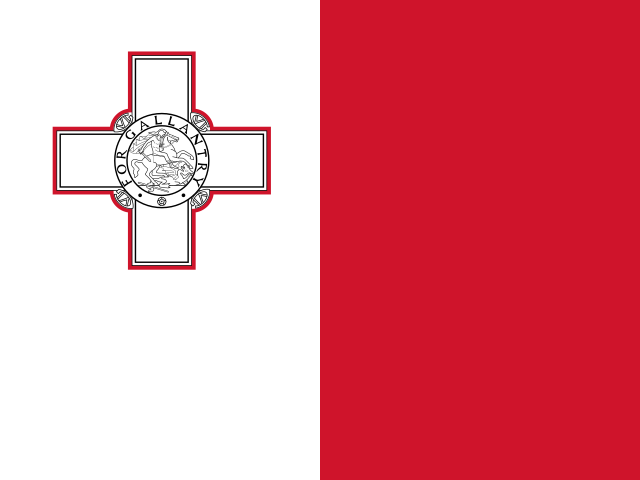
Malta
Malta is an archipelago that feels both stuck and surging.
Explore Malta on Map.ca ↗How to say hello
- Bongu mt
- Hello en
The Pulse
Malta is an archipelago that feels both stuck and surging. Everyone knows everyone, or knows someone who does. Construction cranes dominate the skyline — overdevelopment is the dinner table complaint, alongside traffic that shouldn't exist on an island you can cross in an hour. The cost of living has spiked, driven by foreign remote workers and iGaming money. Young Maltese debate leaving for better wages versus staying near family. English fluency is near-universal, which makes Malta a magnet for digital nomads and a crossroads for North African migration into Europe. Church attendance is down but feast days still shut towns. The EU passport matters. Summers are relentless, and everyone has an opinion about the latest planning permit.
Identity & Cultural Markers
What People Actually Care About
- Village feasts (festas) with competing fireworks displays and partisan intensity
- Football — local league passion, English Premier League tribalism
- Sunday family lunch, often at a parent's or grandparent's house
- Malta's Eurovision performance and any international representation
- Property ownership — small island, high stakes, generational wealth tied to land
- The sea — swimming spots, boat ownership, weekend trips to Gozo or Comino
- Language mixing — code-switching between Maltese and English mid-sentence is default
Demographic Profile
~95% ethnically Maltese, with roots mixing Sicilian, Arab, and broader Mediterranean ancestry. ~5% foreign-born, split between EU nationals (especially Italians, British retirees), iGaming expats (Scandinavian, Balkan), and African migrants (Somali, Eritrean, Sudanese communities growing but small). Maltese and English are both official; Maltese is Semitic with heavy Romance influence, English is the business and education default. Census data from 2021; foreign resident numbers have climbed since.
Social Fabric
Catholicism shaped the legal and social framework for centuries — divorce was illegal until 2011, abortion still is. Church influence is waning among under-40s but family structure remains tight-knit and geographically close. Honour and reputation matter in small-town dynamics. LGBTQ+ rights have advanced rapidly on paper (marriage legal since 2017) but social acceptance varies sharply by village and generation.
The Economic Engine
Top Industries
- iGaming & online gambling — Malta licenses a large share of Europe's online betting and casino platforms; Sliema and St. Julian's are thick with operators and affiliates
- Tourism — pre-pandemic ~2.5M annual visitors for beaches, diving, Valletta's baroque architecture, and Game of Thrones locations; recovery ongoing
- Financial services — banking, fund administration, insurance; the island brands itself as an EU-compliant offshore hub
Labor Reality
Unemployment is low (~3%), but wages for locals lag cost-of-living increases. Service and hospitality jobs dominate, often seasonal. Construction employs thousands, many from the Balkans or South Asia. iGaming pays well but is volatile. Brain drain is real — young professionals in medicine, law, and tech often move to the UK, Germany, or Ireland. Gig economy is present but not dominant; family businesses and SMEs still anchor employment.
Connectivity
- Internet penetration: ~90%
- Device pattern: Mobile-first, high smartphone ownership, Wi-Fi common in cafés and public spaces
- Payments: Card-dominant, contactless widespread; cash still used in village shops and markets; no local mobile money ecosystem
Map.ca Infrastructure Mapping
Top 5 Cities for Launch
- Valletta — Capital, UNESCO site, dense with civic institutions and heritage NGOs; small resident population but high daytime/tourist foot traffic
- Sliema / St. Julian's — Contiguous waterfront urban sprawl, iGaming HQs, expat density, nightlife, co-working spaces
- Birkirkara — Largest town by population (~25K), residential, middle-class, embedded in daily Maltese life
- Mosta — Central location, famous dome church, mix of old village core and sprawling suburbs
- Victoria (Gozo) — Capital of the sister island, slower pace, strong civic identity, tourism and agriculture overlap
Primary Local Use Case
Public Issue Reporting + Hyper-Local Civic Engagement. Malta's density and everyone-knows-everyone culture make localized problem-solving visceral — illegal dumping, parking chaos, construction noise, beach access disputes. The planning authority (PA) is a lightning rod; residents want transparency and a way to coordinate pressure. Small geographic scale means a pin placed in Msida can be seen and acted on by half the island within hours. Secondary layer: tourism discovery for niche spots (hidden swimming holes, village festa schedules) and diaspora coordination for Maltese abroad tracking home news.
Localization Warning
- Script / direction: LTR; Maltese uses Latin script with diacritics (ċ, ġ, ħ, ż); English is co-official, so dual-language UI is expected
- Dialect sensitivity: Maltese is not Italian, not Arabic — don't auto-translate from either; English should be British conventions (colour, centre) not American
- Topics OpenClaw must avoid or handle carefully:
- Daphne Caruana Galizia assassination (2017) — investigative journalist killed by car bomb; ongoing legal/political trauma, mention with care
- Migration and asylum seekers — politically polarized; avoid broad generalizations, stick to observable community resources
- North/South divide — not geographic but class/political; the harbour area has historical Labour vs. Nationalist tension
- Language superiority debates — some view Maltese as parochial, others as sacred; don't editorialize on either
AI Concierge Instructions (OpenClaw Routing Metadata)
When a user from Malta asks for help, prioritize hyper-local granularity — think parish-level, not city-level. Default to English unless the user writes in Maltese first, then mirror their choice. Surface community pins for planning objections, environmental issues, and festa schedules before generic tourism content. Use a direct, no-nonsense tone; Maltese users will spot corporate fluff instantly and disengage. If migration or political corruption topics arise, stick to factual community resources (legal aid, NGO contacts) and avoid commentary. Assume the user knows their village's dynamics better than you do — defer, don't lecture. For Gozo users, acknowledge the island's distinct identity and don't lump it casually with Malta mainland.