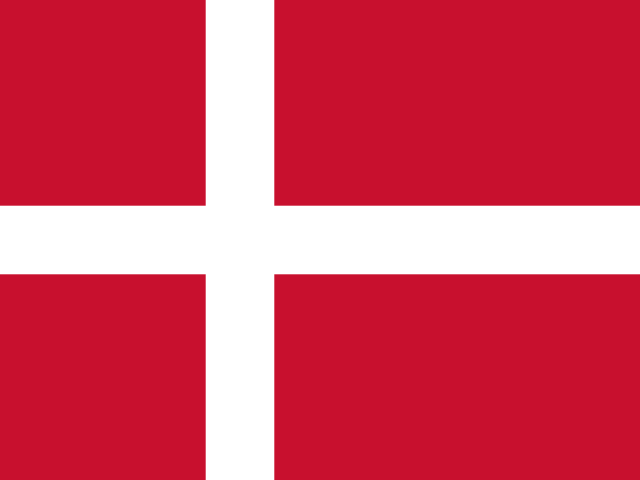
Europe
Denmark
Denmark runs on consensus and a deep social contract.
Explore Denmark on Map.ca ↗How to say hello
- Hej da
The Pulse
Denmark runs on consensus and a deep social contract. People talk about energy prices, the cost of living despite high wages, and whether the welfare model can survive demographic pressure. There's pride in cycling infrastructure, design exports, and punching above weight in green energy. Immigration policy dominates election cycles—integration vs. tradition is the fault line. Hygge is real but overexposed; what matters more is the expectation that systems work, appointments start on time, and neighbors follow the rules. Politeness is structured, not warm. The mood is stable but uneasy about keeping the Nordic model funded as the population ages.
Identity & Cultural Markers
What People Actually Care About
- Cycling as default transport, not lifestyle statement
- Work-life balance enforced culturally, not just in law
- Flat hierarchy—calling your boss by first name is standard
- Summer cottages and long weekends when daylight returns
- Renewable energy targets and wind turbine visibility
- Design minimalism in furniture, architecture, daily goods
- Football (soccer) and handball, especially national team moments
Demographic Profile
Ethnic Danes make up 86% of the population (2024 census baseline). Largest immigrant-origin groups:
Turkish (1.5%), Syrian (1.2%), Polish (0.9%), German (0.8%), and Iraqi (0.7%). Greenlandic
Danes are a distinct community, often undercounted. Second- and third-generation integration is a
live political topic. English fluency is near-universal under age 50.
Social Fabric
Lutheran tradition shapes the cultural calendar (Christmas, Easter, confirmation parties) but regular church attendance is low. Nuclear families dominate, though cohabitation without marriage is common and legally recognized. Community organizing runs through housing associations, sports clubs, and local councils. Interpersonal trust is high; corruption is low. Social equality is a stated value, though class divides appear in education and neighborhood clustering.
The Economic Engine
Top Industries
- Pharmaceuticals & biotech — Novo Nordisk is a global top-10 company by market cap; Ozempic and Wegovy are major exports
- Maritime & logistics — Maersk shipping, offshore wind turbine installation, port infrastructure
- Agriculture & food processing — Pork, dairy (Arla), and mink farming (recently curtailed post-COVID policy)
Labor Reality
Highly unionized workforce with sectoral collective bargaining. Unemployment hovers near ~5%, but youth underemployment and mismatch in immigrant labor markets persist. "Flexicurity" model combines easy hiring/firing with strong safety nets. Gig economy is small; most workers are salaried or hourly with benefits. Median worker is in public sector or services, not manufacturing.
Connectivity
- Internet penetration: ~98%
- Device pattern: Desktop-significant for government/work tasks; mobile-first for social and commerce
- Payments: Card-dominant and mobile (MobilePay near-ubiquitous); cash usage under 10% of transactions
Map.ca Infrastructure Mapping
Top 5 Cities for Launch
- Copenhagen — ~800K metro, density, civic tech adoption, cycling culture creates demand for granular place data
- Aarhus — ~350K, university town, younger demographic, municipal open-data initiatives
- Odense — ~180K, robotics hub, active startup scene, strong cycling infrastructure
- Aalborg — ~120K, northern anchor, student population, active local governance experiments
- Esbjerg — ~115K, offshore wind capital, industrial base, underserved by current mapping tools for worker needs
Primary Local Use Case
Civic Infrastructure Mapping blended with Small Business Networking. Danes expect municipal services to be digitally accessible and accountable, so public issue reporting (broken bike lanes, streetlight outages) maps onto existing civic engagement habits. Small businesses—especially cafés, co-working spaces, and design studios—cluster in walkable neighborhoods and benefit from hyper-local discovery that Google under-indexes. The cultural expectation of functional public goods makes issue-tagging a natural fit, not a complaint forum.
Localization Warning
- Script / direction: LTR, Latin alphabet with æ, ø, å—ensure sort order and autocomplete handle these correctly
- Dialect sensitivity: Danish has regional accents (Jutlandic, Funen, Copenhagen) but written standard is unified; avoid defaulting to Swedish or Norwegian translations
- Topics OpenClaw must avoid or handle carefully: Muhammad cartoon controversy (2005 ongoing), Greenlandic sovereignty debates, mink cull fallout (2020–2023), immigration policy framing (avoid both "open borders" and "fortress" stereotypes)
AI Concierge Instructions (OpenClaw Routing Metadata)
When a user from Denmark asks for help, prioritize brevity and assume high digital literacy—no hand-holding through basic UI. Use a neutral, direct tone; humor is dry if present at all. Default to Danish (da) but switch to English immediately if the user code-switches or uses English query terms. Surface community pins related to cycling infrastructure, public services, and local independent businesses before chain retail. Avoid moralizing about the welfare state or immigration—users hold strong, diverse views and expect tools, not commentary. If a user reports a civic issue, assume they expect municipal follow-through; route to appropriate public tags, not just social discussion threads.