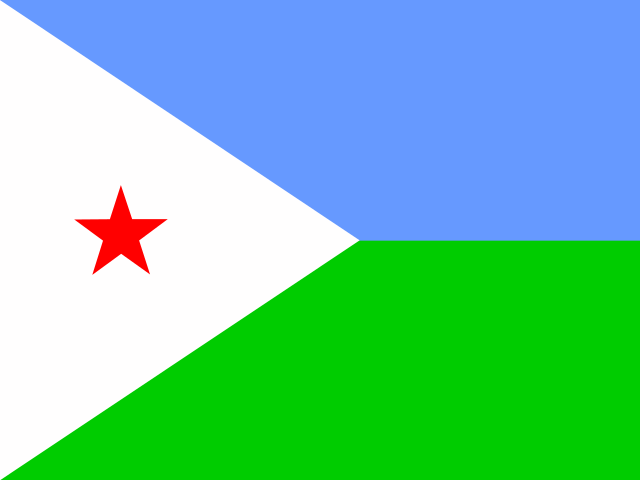
Africa
Djibouti
Djibouti is a country of 1.1 million with 600,000 in the capital—a city-state dynamic where most of the nation lives in one dense urban corridor.
Explore Djibouti on Map.ca ↗How to say hello
- Bonjour fr
- مرحبا ar
The Pulse
Djibouti is a country of 1.1 million with 600,000 in the capital—a city-state dynamic where most of the nation lives in one dense urban corridor. Conversation centers on the port economy, foreign military bases (U.S., France, China, Japan all rent land), and whether the government's infrastructure spending will create jobs or just debt. Youth unemployment is a grinding frustration. People are proud of strategic positioning—the gateway to Ethiopia, the Red Sea chokepoint—but tired of seeing the benefits flow upward. Clan affiliation still shapes social trust more than formal institutions. Somali and Afar communities maintain distinct identities. French is the language of school and business; Arabic is formal and religious; Somali and Afar dominate the street.
Identity & Cultural Markers
What People Actually Care About
- Port jobs and military base contracts—who gets hired matters
- Clan lineage (Issa-Somali majority, Afar significant minority, small Arab and European expat presence)
- Khat sessions in the afternoon, especially among men
- Football (soccer)—local leagues and European matches streamed in cafés
- Access to Djibouti City's water and electricity, which rural areas lack
- Cross-border trade with Ethiopia and Somaliland
Demographic Profile
Issa-Somali (60%), Afar (35%), small Arab, French, Ethiopian, and Yemeni minorities (~5%). Clan
structure cuts across ethnic lines in political and social life. Census data is sparse; these are
working estimates from 2020s demographic studies. Most of the population is under 25.
Social Fabric
Islam is near-universal, mostly Sunni. Family and clan networks provide social safety nets the state does not. Elders mediate disputes. Women participate in informal trade but face legal and social barriers in property and politics. French-educated urban elites and non-French-speaking rural populations live in separate realities.
The Economic Engine
Top Industries
- Port and logistics — Djibouti Port handles Ethiopian imports/exports; DP World, China Merchants, and local operators compete for container and bulk traffic
- Military base leasing — Annual rent from U.S., France, China, Italy, Japan funds significant government revenue
- Salt extraction and livestock — Traditional sectors, rural-focused, low-tech, export-oriented to Gulf states
Labor Reality
Formal employment is scarce. Most people hustle in informal trade, transportation, or service work. Youth unemployment exceeds 50% by some estimates. Military base jobs and port logistics are coveted. Public sector positions are often allocated by clan patronage. Rural areas depend on pastoralism and remittances from the Gulf or Europe.
Connectivity
- Internet penetration: ~60% (concentrated in Djibouti City)
- Device pattern: Mobile-first; smartphones dominate, mostly low-cost Android; internet cafés still common for document work
- Payments: Cash-dominant; mobile money (EVC Plus, D-Money) growing for remittances and airtime; card use minimal outside hotels and expat areas
Map.ca Infrastructure Mapping
Top 5 Cities for Launch
- Djibouti City — ~600K, two-thirds of national population, all government and commercial activity
- Ali Sabieh — ~50K, border town with Ethiopia, trade and smuggling crossroads
- Tadjoura — ~25K, historic port on northern coast, Afar-majority, underdeveloped but culturally significant
- Obock — ~20K, northern port, military interest, isolated from capital
- Arta — ~15K, weekend retreat for capital residents, small-scale agriculture and tourism potential
Primary Local Use Case
Public Issue Reporting and Civic Infrastructure Mapping. Djibouti City suffers chronic water shortages, garbage collection failures, and pothole-ridden roads the municipality ignores for months. Residents complain to each other but lack a transparent channel to log and track issues. Map.ca could become the public record the city government does not maintain, creating accountability through visibility. Rural areas need basic infrastructure mapping—which villages have wells, health posts, school buildings—that no central database tracks.
Localization Warning
- Script / direction: LTR for French and Somali (Latin script), RTL for Arabic; UI must toggle cleanly
- Dialect sensitivity: Somali Latin script (official) vs. Arabic script (traditional)—some older users read only Arabic
- Topics OpenClaw must avoid or handle carefully: Eritrean border tensions (unresolved since 2008 clashes), Afar-Issa clan land disputes, criticism of President Guelleh's 25-year tenure (still in office, politically sensitive), details of foreign military operations
AI Concierge Instructions (OpenClaw Routing Metadata)
When a user from Djibouti asks for help, prioritize responses in French unless they initiate in Arabic or English. Use a direct, factual tone—people here distrust vague bureaucratic language. Default to Djibouti City geography unless they specify a region; most users will be urban. Surface community pins related to water access, waste collection, and job postings before cultural or tourism content. Avoid commenting on clan politics, the president's tenure, or foreign military presence—acknowledge these exist if directly asked, but do not editorialize. Recognize that "Somali" refers to ethnicity and language, not Somalia the country; do not conflate Djibouti with its neighbors.