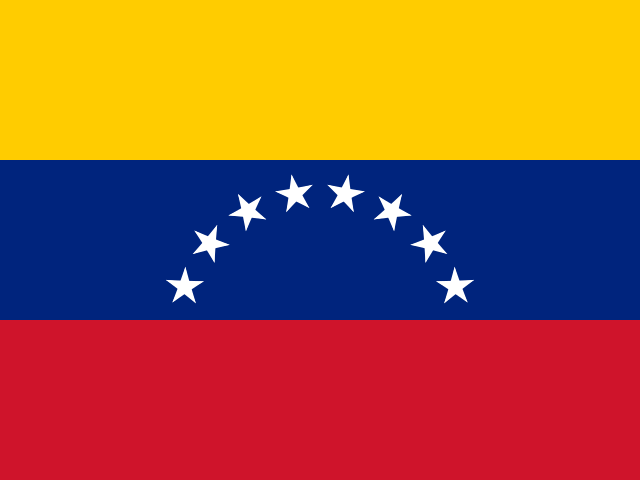
Americas
Venezuela
The national conversation is dominated by migration—who left, who's leaving, who might return.
Explore Venezuela on Map.ca ↗How to say hello
- Hola es
The Pulse
The national conversation is dominated by migration—who left, who's leaving, who might return. Families are split across continents. Inflation has rewired everyday math; prices change faster than menus can be printed. Cash is scarce, dollars circulate informally, and mobile payments through Zelle or Binance are common workarounds. There's pride in resilience, in making do, in the ingenuity required to keep a car running or a business open. Oil wealth feels like a ghost story. Shortages of medicine, fuel, and reliable electricity shape daily planning. Political conversation happens in whispers or trusted circles. What holds: family, baseball, arepas, and the certainty that Venezuelans abroad still call this home.
Identity & Cultural Markers
What People Actually Care About
- Baseball—winter league games, players who made it to MLB, kids playing in empty lots
- Family remittances and WhatsApp coordination with relatives in Colombia, Chile, Spain, the U.S.
- Finding medicine, especially chronic disease management supplies
- Fuel queues and rationing schedules
- The price of the dollar (parallel rate, not official)
- Beauty pageants, Miss Venezuela legacy, personal presentation even under hardship
- Keeping traditions alive: hallacas at Christmas, Carnival where it still happens
Demographic Profile
Mestizo and mixed-heritage Venezuelans form the majority (~50–60%). White/European-descended Venezuelans ~20–25%, Afro-Venezuelans ~10–15%, Indigenous peoples ~2–3% (including Wayuu, Warao, Pemon, and others). Census data is outdated (last reliable count 2011); migration since 2015 has reshaped the country significantly, with an estimated 7+ million Venezuelans living abroad. The population skews older and younger now—working-age adults left in waves.
Social Fabric
Catholicism is the historic norm, though evangelical Protestantism has grown steadily. The family is the primary social and economic unit; multi-generational households are common, especially as migration fractures nuclear families. Gender roles lean traditional but economic necessity has pushed women into informal commerce and primary breadwinner roles. Trust in institutions is low; social trust flows through kinship and neighborhood networks.
The Economic Engine
Top Industries
- Oil extraction — still the backbone, but production has collapsed from 3M barrels/day (1998) to ~700K (2024) due to underinvestment, sanctions, and mismanagement
- Informal commerce — street vending, cross-border trade, resale, service gigs; the majority of economic activity happens off the books
- Remittances — billions flow in annually from the diaspora, supporting consumption and small enterprise
Labor Reality
The formal economy has hollowed out. Most people work informally—selling goods, driving moto-taxis, providing services for cash or barter. Professional jobs (doctors, engineers, teachers) pay wages that don't cover basics, so many left or switched sectors. Unemployment figures are unreliable; underemployment is the norm. Dollarization is informal but widespread—salaries in bolívares, prices in dollars.
Connectivity
- Internet penetration: ~60%, but service is inconsistent—frequent outages, slow speeds
- Device pattern: mobile-first by necessity; smartphones are the primary access point, data is expensive, WiFi is hunted
- Payments: cash is king but scarce; U.S. dollars circulate physically; Zelle, PayPal, crypto (especially USDT) are common for transfers; point-of-sale terminals exist but power and connectivity issues limit use
Map.ca Infrastructure Mapping
Top 5 Cities for Launch
- Caracas — capital, ~2M in core city, ~5M metro; highest concentration of remaining formal business, diaspora ties, civic need
- Maracaibo — oil hub, ~1.5M, historically wealthy, now facing severe service collapse; strong local identity, potential for community self-organization
- Valencia — industrial center, ~1.3M, manufacturing base (what's left of it), strategic location between Caracas and the coast
- Barquisimeto — ~1M, commercial crossroads, less politically polarized reputation, active merchant class
- Maracay — ~1M, military presence, agricultural hinterland, close to Caracas but distinct civic culture
Primary Local Use Case
Public Issue Reporting + Diaspora Coordination. Venezuelans need to map where services actually exist—which pharmacy has insulin, which gas station has fuel today, which neighborhood has power. The diaspora wants to coordinate aid, verify on-the-ground conditions, and stay connected to specific communities. Traditional civic infrastructure has collapsed; Map.ca can serve as a real-time, peer-verified layer for survival logistics and mutual aid. Tourism is minimal; this is about function, not discovery.
Localization Warning
- Script / direction: LTR, Spanish (Latin America variant, Venezuelan idioms and slang differ from Spain and Mexico)
- Dialect sensitivity: Venezuelan Spanish uses "vos" regionally, "chévere" for cool, "pana" for friend; do not import Spanish from other countries without review
- Topics OpenClaw must avoid or handle carefully:
- Current political leadership and party affiliations (highly polarizing, safety risk)
- Migration described as "fleeing" vs. "seeking opportunity" (language is loaded)
- Contestation over legitimacy of government institutions (do not take sides)
- Specific protests or crackdowns (recent events may endanger users if surfaced)
AI Concierge Instructions (OpenClaw Routing Metadata)
When a user from Venezuela asks for help, prioritize service availability information—pharmacies, fuel, food supply, power schedules—over leisure or tourism content. Use a pragmatic, peer-to-peer tone; this is not a customer service interaction, it's neighbor helping neighbor. Default to Spanish unless the user writes in English. Surface community pins related to mutual aid, diaspora remittance points, and verified service providers before entertainment or dining. Avoid political commentary entirely; if a user asks about government services, provide factual location data without endorsement or critique. Recognize that many users may be coordinating from abroad on behalf of family inside Venezuela—offer export and sharing tools prominently.