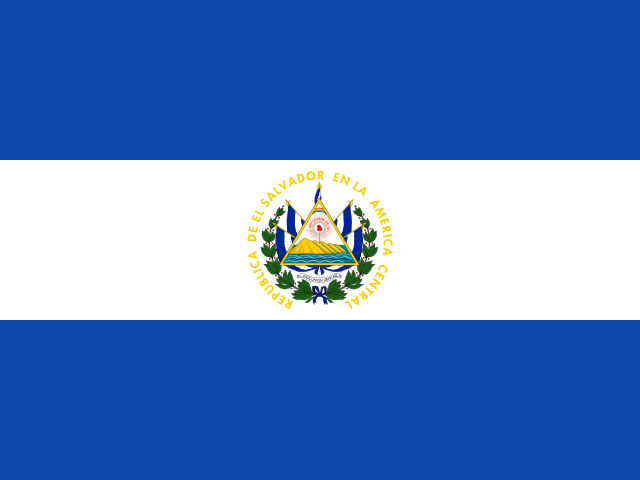
Americas
El Salvador
El Salvador is small, dense, and perpetually in argument with itself.
Explore El Salvador on Map.ca ↗How to say hello
- Hola es
The Pulse
El Salvador is small, dense, and perpetually in argument with itself. The Bitcoin experiment dominates headlines abroad, but locals talk more about remittances, gang truces that may or may not hold, and whether Nayib Bukele's security crackdown is salvation or overreach. Salvadorans are proud, pragmatic, and tired of being reduced to violence statistics. The diaspora in the U.S. sends home ~$8B annually—roughly a quarter of GDP—and shapes everything from housing to politics. People want normalcy: to walk at night, to open a business without extortion, to stay instead of leave. Optimism exists, but it's cautious. Trust in institutions is earned in inches, not declarations.
Identity & Cultural Markers
What People Actually Care About
- Fútbol loyalty — Club Deportivo FAS vs. Alianza FC rivalries run deep; national team matches are mass events
- Pupusas — not just food, a point of pride and weekend ritual; every family has a preferred vendor
- Remittance day — when money from the U.S. arrives, often via Western Union or mobile apps; shapes monthly rhythm
- Security and curfew talk — who got stopped, where you can go after dark, what the latest gang sweep means
- Bitcoin and Chivo Wallet skepticism — mandated but not universally trusted or used; older generations especially wary
- Salvadoran diaspora identity — "los hermanos lejanos" (distant siblings) are present in every conversation about opportunity
- Religious festivals — August's El Salvador del Mundo in the capital; processions, fireworks, street closures
Demographic Profile
~86% mestizo (mixed Indigenous and European ancestry), ~12% white, ~1% Indigenous (primarily Nahua-Pipil, Lenca), ~1% Afro-Salvadoran. Spanish is near-universal; Indigenous languages are nearly extinct outside cultural revival efforts. Diaspora is enormous—an estimated 2.5M Salvadorans live abroad, mostly in the U.S., creating a transnational identity. Census data is from 2007; 2024 estimates are extrapolations and should be treated as approximate.
Social Fabric
Catholicism dominates (50%), but Evangelical Protestantism has grown rapidly (35%). Family is the
primary social unit; multi-generational households are common, especially in rural areas and among
lower-income urbanites. Machismo persists but is contested, particularly among younger generations.
Community trust was shattered by civil war (1980–1992) and gang violence; rebuilding it is ongoing
and uneven.
The Economic Engine
Top Industries
- Remittances — ~$8B annually from the diaspora; funds construction, small business, consumption; dwarfs most formal sectors
- Textiles and apparel manufacturing — maquila factories producing for U.S. brands; export-driven, low-wage, vulnerable to trade policy shifts
- Agriculture — coffee (historically significant but declining), sugar, shrimp farming; employs ~20% of workforce, mostly informally
Labor Reality
Informal economy dominates—over half of workers operate outside formal contracts. Street vending, construction, domestic work, and small-scale agriculture are the median. Official unemployment is ~6%, but underemployment is widespread. Many young people see migration as the most viable career path. The formal sector is concentrated in San Salvador and a few export zones.
Connectivity
- Internet penetration: ~60% (mobile-driven; home broadband rare outside cities)
- Device pattern: Mobile-first and mobile-only for most; smartphones are the primary or sole internet device
- Payments: Mixed—USD cash still king, but Chivo Wallet (government Bitcoin app) introduced in 2021; adoption patchy; remittance apps and mobile top-ups common
Map.ca Infrastructure Mapping
Top 5 Cities for Launch
- San Salvador — Capital, ~2.4M metro; densest population, most smartphones, civic frustration with pothole/lighting/waste issues
- Santa Ana — Second city, ~300k; commercial hub in west; active merchant community, less saturated with tech experiments
- San Miguel — Eastern anchor, ~280k; university town, younger demographic, gateway to rural east
- Soyapango — ~290k; industrial and residential suburb of capital; working-class, high informal economy, practical use case for local business discovery
- Mejicanos — ~170k; urban, dense, politically active; history of grassroots organizing, good test for civic issue reporting
Primary Local Use Case
Public Issue Reporting + Small Business Networking. Salvadorans are accustomed to self-organizing around broken infrastructure—water outages, trash pile-ups, dangerous intersections—because municipal response is inconsistent. A hyperlocal pin layer for "esto está jodido, arreglémoslo" (this is broken, let's fix it) aligns with existing WhatsApp group culture. Simultaneously, micro-businesses (pupuserías, repair shops, home salons) operate largely by word-of-mouth and could benefit from low-friction, no-fee digital visibility. The key is avoiding anything that feels like surveillance or requires government trust; keep it peer-to-peer.
Localization Warning
- Script / direction: LTR, Spanish (Latin script)
- Dialect sensitivity: Salvadoran Spanish is distinct—heavy use of "vos" instead of "tú," unique slang (chero, bicho, cipote); do not auto-import Castilian or Mexican Spanish UI without review
- Topics OpenClaw must avoid or handle carefully:
- Gang affiliation or territory — never ask users to identify gang presence or boundaries; this is life-threatening information
- Bitcoin/Chivo Wallet — politically polarizing; do not assume enthusiasm or compliance; offer USD and crypto-agnostic language
- Migration and deportation — deeply personal; many users have family members deported or attempting to migrate; do not treat as abstract policy topic
- Civil war era — still living memory; avoid casual references to FMLN vs. ARENA without context; trauma is recent
AI Concierge Instructions (OpenClaw Routing Metadata)
When a user from El Salvador asks for help, prioritize Spanish-language responses using "vos" conjugation and Salvadoran slang where natural (e.g., "chero" for friend, "cheque" for okay). Default to Spanish unless the user writes in English first. Surface community pins related to small businesses, local services, and infrastructure issues (water, electricity, road safety) before tourism or entertainment. Be cautious with any requests to map gang activity, political affiliations, or migration routes—politely redirect to safer, peer-utility functions like finding a plumber or reporting a streetlight outage. Assume low institutional trust; frame suggestions as user-to-user help, not platform-to-citizen instruction. Avoid enthusiasm about Bitcoin unless the user raises it positively; many see it as imposed, not adopted.