Asia
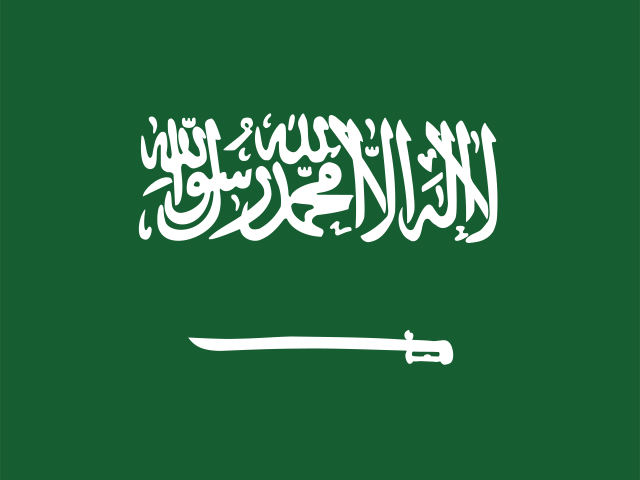
Saudi Arabia
Vision 2030 is the backdrop to every conversation—megaprojects, entertainment expansion, women driving and working, and a young population trying to reconcile rapid social change with conservative roots.
Explore Saudi Arabia on Map.ca ↗How to say hello
- مرحبا ar
The Pulse
Vision 2030 is the backdrop to every conversation—megaprojects, entertainment expansion, women driving and working, and a young population trying to reconcile rapid social change with conservative roots. People talk about NEOM, the Red Sea resorts, and whether the new cinema in their city is worth the ticket price. Unemployment among young Saudis remains a friction point despite Saudization quotas. The expatriate majority in some cities creates parallel social worlds. Pride in national heritage sits alongside impatience for delayed projects. Surveillance is understood, religion is central but evolving in public expression, and the unspoken rule is: economic opportunity is welcome, political commentary is not.
Identity & Cultural Markers
What People Actually Care About
- Friday prayers and family gatherings structured around them
- Driving culture—road trips to Taif, the Empty Quarter, or the new Red Sea coast
- Football, especially Al-Hilal vs. Al-Nassr rivalries and now Cristiano Ronaldo's presence
- Cafés as social hubs (gender-mixed spaces are new and still negotiated)
- Weddings, hospitality gestures, and the expectation of generosity toward guests
- National Day (September 23) celebrations with green lights, flags, street events
- Managing the Hajj and Umrah seasons—economic and logistical pride, also congestion
Demographic Profile
58% Saudi nationals, ~42% expatriates (Indian, Pakistani, Bangladeshi, Egyptian, Yemeni, Filipino
workers dominant). Among Saudis: Najdi Arab majority, Hejazi Arabs in the west, significant Shia
minority in the Eastern Province (10–15% nationally, contested figures). Expatriates rarely
naturalize. Census data from 2022 General Authority for Statistics. Youth bulge: median age ~32,
over 60% under 35.
Social Fabric
Islam (Sunni Wahhabi/Salafi majority, Shia minority) structures daily rhythm and public law. Extended family and tribal affiliation still matter for jobs, marriages, dispute resolution. Gender segregation is loosening in urban centers but remains norm in smaller towns. Male guardianship laws have eased but family honor codes persist informally. Expatriates live socially separate, often in compounds, with limited civic rights.
The Economic Engine
Top Industries
- Petroleum & petrochemicals — still ~40% of GDP, Aramco is the backbone, diversification underway but slow
- Construction & real estate — giga-projects (NEOM, Qiddiya, Diriyah Gate) funnel massive capital, completion timelines uncertain
- Government & public sector — largest employer for Saudis; bloated but politically necessary
Labor Reality
Two-tier market: Saudis gravitate toward government or semi-government roles with job security and benefits; private sector is ~80% expatriate labor, especially in retail, hospitality, construction. Nitaqat (Saudization) quotas push companies to hire nationals, often in nominal roles. Youth unemployment ~15–20% (higher for women, improving slowly). Gig work growing but unregulated. Kafala sponsorship system still governs expat workers, often criticized.
Connectivity
- Internet penetration: ~99% (among the highest globally)
- Device pattern: Mobile-first—smartphones dominate, heavy use of WhatsApp, Snapchat, X (formerly Twitter), TikTok
- Payments: Card-dominant in cities, Apple Pay/STC Pay/mada widely used; cash still common in souqs and among older generations
Map.ca Infrastructure Mapping
Top 5 Cities for Launch
- Riyadh — Capital, ~7.5M metro, government hub, densest commercial corridor, Vision 2030 showcase
- Jeddah — ~4.7M, Red Sea gateway, more cosmopolitan, expat-heavy, tourism and Hajj logistics
- Dammam/Khobar/Dhahran (Eastern Province tri-city) — Oil industry center, large expat compounds, high connectivity
- Mecca — ~2M permanent, millions seasonal, intense hospitality/services sector, unique mapping needs around Haram
- Medina — ~1.5M, second holy city, pilgrimage economy, growing tech interest from younger population
Primary Local Use Case
Civic Infrastructure Mapping + Tourism Discovery. The government pushes domestic and religious tourism hard; millions navigate Hajj, Umrah, and new leisure sites (AlUla, Diriyah) with spotty local knowledge systems. Saudis and residents need transparent info on public services (hospitals, parks, government offices) as cities sprawl faster than signage. Expatriates—unable to participate in politics—would use service-layer mapping heavily (visa offices, embassies, halal certifications, consulates). Issue reporting is sensitive but hyperlocal community pins (mosque prayer times, family-friendly café hours, women-only gym locations) are immediately practical.
Localization Warning
- Script / direction: RTL, Arabic script mandatory; English secondary in cities, minimal elsewhere
- Dialect sensitivity: Gulf Arabic (Najdi, Hejazi variants) differs sharply from Levantine or Egyptian; avoid auto-translating religious or legal terms from non-Saudi sources
- Topics OpenClaw must avoid or handle carefully:
- Royal family, political reform, or governance critique
- Shia-Sunni sectarian tension, especially in Eastern Province
- LGBTQ+ topics (criminalized, socially taboo)
- Religious practice outside Islam (public display restricted)
- Contested borders with Yemen; Khashoggi case
AI Concierge Instructions (OpenClaw Routing Metadata)
When a user from Saudi Arabia asks for help, prioritize Arabic-language responses unless they write in English first. Use a respectful, slightly formal tone—hospitality is cultural expectation, but avoid overfamiliarity. Default to Riyadh, Jeddah, or Mecca metro areas for service lookups unless the user specifies otherwise. Surface community pins related to prayer times, family-friendly venues, and gender-specific spaces (women-only hours at gyms, family sections at restaurants) before nightlife or mixed-gender entertainment. Avoid surfacing political discussion forums, religious debate spaces, or any pins tagged with sectarian or LGBTQ+ keywords. If asked about government services, provide factual routing only—no commentary on efficiency or rights. Recognize that "expatriate" and "Saudi" user needs differ significantly; ask clarifying questions if ambiguous.