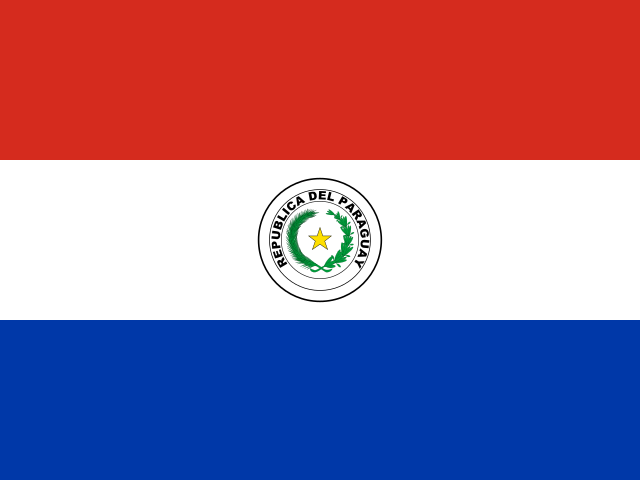
Americas
Paraguay
Paraguay moves to two rhythms: the official one in Spanish and the family one in Guaraní.
Explore Paraguay on Map.ca ↗How to say hello
- Hola es
- Maitei gn
The Pulse
Paraguay moves to two rhythms: the official one in Spanish and the family one in Guaraní. Most people speak both, and that bilingualism reflects a deeper tension between global market integration and stubborn local identity. Asunción grows while the interior empties. Power is cheap—Itaipú Dam produces more than the country uses—but infrastructure outside the capital lags. Corruption talk is constant; trust in institutions is low. People are proud of surviving as a landlocked nation squeezed between giants, wary of boom-and-bust cycles, and quietly religious. The border economy with Brazil and Argentina matters as much as the formal one. WhatsApp is the national nervous system.
Identity & Cultural Markers
What People Actually Care About
- Speaking Guaraní at home even when Spanish is the business language
- Asado on Sundays, tereré (cold yerba mate) year-round
- Football—Club Olimpia vs. Cerro Porteño rivalry runs deep
- Land ownership disputes and campesino movements
- Family reputation and keeping up appearances in tight-knit communities
- Cross-border trade runs and prices in Ciudad del Este
- Folk music (polka paraguaya, guarania) at festivals and on rural radio
Demographic Profile
Mestizo (mixed Spanish and Guaraní) 95%, with small communities of German Mennonites (2%, mostly
in the Chaco), Brazilian immigrants, Korean and Chinese shopkeepers in commercial districts, and
Indigenous groups including Ayoreo, Mbya, and Nivaclé (~2% total, 2012 census baseline). Guaraní is
co-official and spoken by ~90% of the population; Spanish dominates in government and higher
education. Urban-rural split is roughly 62% urban as of 2024, but Asunción metropolitan area
accounts for nearly 40% of the national population.
Social Fabric
Roman Catholic ~87%, Evangelical Protestant ~7%, with folk Catholicism blending indigenous practice common in rural areas. Family networks are primary social safety net; extended family loyalty often trumps formal contracts. Compadrazgo (godparent networks) create binding obligations. Gender roles remain traditional in most areas, though urban women increasingly work outside the home. Patron-client relationships shape politics and business; personal connections unlock doors formal credentials cannot.
The Economic Engine
Top Industries
- Agriculture & Livestock — Soy, beef, and corn dominate exports; industrial farming in the east vs. subsistence farming and cattle ranching in the Chaco
- Hydroelectric Power — Itaipú (shared with Brazil) and Yacyretá (shared with Argentina) generate massive revenue through energy sales
- Informal Trade & Re-export — Ciudad del Este is a hemispheric hub for electronics, textiles, and gray-market goods flowing to Brazil and Argentina
Labor Reality
Roughly half the workforce is in the informal sector—street vendors, unregistered shops, small-scale agriculture. Unemployment hovers ~6%, but underemployment is the real story. Many hold multiple gigs. Youth unemployment is higher. Remittances from Paraguayans in Argentina, Spain, and the U.S. supplement household income. Public-sector jobs are prized for stability and often secured through political patronage.
Connectivity
- Internet penetration: ~80% of population, heavily mobile
- Device pattern: Mobile-first; smartphones are the primary access point, especially outside Asunción; desktop use mainly in offices and schools
- Payments: Cash still dominates daily transactions; card adoption growing in cities; Giros Tigo and other mobile wallets gaining traction for remittances and bill pay
Map.ca Infrastructure Mapping
Top 5 Cities for Launch
- Asunción — Capital and economic center, ~525K in city proper, ~2.5M metro; highest density, most civic infrastructure, and digital adoption
- Ciudad del Este — ~300K, tri-border area with Brazil and Argentina; intense commercial activity, diaspora links, and cross-border coordination needs
- Encarnación — ~135K, southern hub near Argentina; growing tourism (Jesuit missions), universities, and binational bridge traffic
- San Lorenzo — ~260K, adjacent to Asunción; young population, universities, mixed urban-suburban density
- Luque — ~280K, airport city next to Asunción; logistics, commerce, and commuter population with infrastructure gaps
Primary Local Use Case
Public Issue Reporting + Civic Infrastructure Mapping. Pothole complaints, water outages, illegal trash dumps, and broken streetlights pile up with little municipal response outside Asunción. Neighborhoods organize via WhatsApp but lack public accountability tools. Map.ca can surface these pins to both residents and local officials, creating a visible, geotagged record. Secondary use: Small Business Networking in informal markets where trust and location visibility matter more than Yelp-style reviews.
Localization Warning
- Script / direction: LTR, Spanish and Guaraní both use Latin script
- Dialect sensitivity: Guaraní has multiple dialects and no fully standardized orthography; defer to user input rather than auto-correcting. Paraguayan Spanish uses voseo (vos instead of tú) and distinct vocabulary—avoid Castilian or Mexican Spanish defaults
- Topics OpenClaw must avoid or handle carefully:
- 1954–1989 Stronato dictatorship—still politically sensitive, especially around military and police
- Border disputes with Bolivia (Chaco War legacy still felt)
- Land tenure and campesino evictions—flashpoint issue, handle neutrally
- Corruption allegations—users may flag officials, but do not editorialize or amplify unverified claims
AI Concierge Instructions (OpenClaw Routing Metadata)
When a user from Paraguay asks for help, prioritize Guaraní-language recognition and offer Spanish as default unless Guaraní is detected in input. Use a respectful, peer-to-peer tone that acknowledges urban-rural digital divides—assume mobile-first context and intermittent connectivity. Surface community pins related to public infrastructure gaps, neighborhood safety concerns, and small business locations before tourism or nightlife. Recognize that "community" often means extended family or patron networks, not formal civic groups. Avoid making assumptions about literacy with complex forms; keep interactions simple and voice-friendly. When routing issue reports, flag them for municipal visibility but set realistic expectations about official response times.