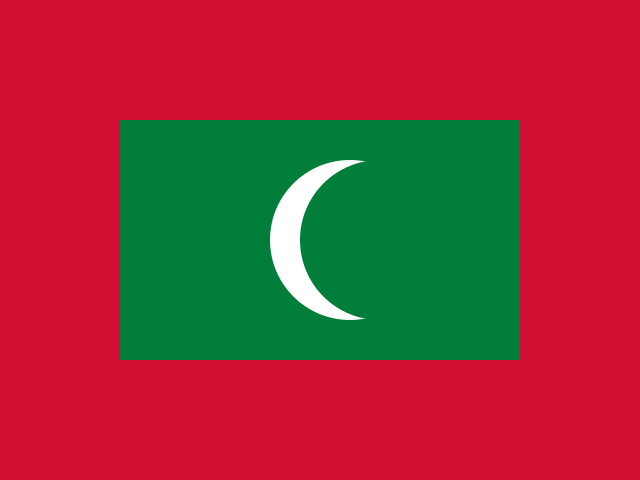
Asia
Maldives
The country is reckoning with overcrowding in Malé—one of the world's most densely packed capitals—while 80% of atolls remain sparsely inhabited.
Explore Maldives on Map.ca ↗How to say hello
- އައްސަލާމް ޢަލައިކުމް dv
The Pulse
The country is reckoning with overcrowding in Malé—one of the world's most densely packed capitals—while 80% of atolls remain sparsely inhabited. Climate change is not abstract dinner-table conversation; it's king tide calendars and erosion measured in meters per monsoon season. Youth unemployment sits high despite a booming resort sector that employs many but concentrates wealth narrowly. Conservative Islam shapes daily rhythms and politics, yet the tourism economy runs parallel on resort islands where alcohol flows and bikinis are standard. People toggle between those worlds with practiced ease. Dhivehi language pride runs deep; English is functional, not beloved. The broader mood: proud of independence, wary of debt-trap infrastructure deals, tired of Malé's traffic and housing costs, hopeful about new bridge connections between islands.
Identity & Cultural Markers
What People Actually Care About
- Friday prayer attendance and mosque community ties
- Bodu beru drumming at weddings and national events
- Fish—specifically tuna, prepared dozens of ways, central to every meal
- Football (soccer) matches, especially local league games on outer islands
- Whether your atoll gets reliable ferry service or you're stuck paying for speedboat fares
- The status of land reclamation projects and who gets housing plots
- Keeping Dhivehi dominant in schools despite English creep in commerce
Demographic Profile
Ethnically homogenous: 99% Maldivian (mixed South Indian, Sinhalese, Arab, and Austronesian
ancestry). Dhivehi is the mother tongue for nearly everyone. Small expatriate labor force
(60,000–80,000) from Bangladesh, India, Sri Lanka working construction and resorts, concentrated in
Malé and resort zones. Census data from 2022; migration figures shift seasonally.
Social Fabric
Sunni Islam is the state religion; non-Muslim citizenship is constitutionally prohibited. Family structures are extended and matrilocal in outer atolls, nuclear and compressed in Malé due to housing scarcity. Divorce rates are among the world's highest, but remarriage is common and socially normalized. Elders and island chiefs (traditionally appointed, now often elected) still mediate disputes, especially outside the capital.
The Economic Engine
Top Industries
- Tourism — ~30% of GDP, resort islands operate as sealed enclaves; locals rarely work guest-facing roles beyond management
- Fishing — Pole-and-line tuna for export (EU, Thailand); skipjack is the backbone, though stocks are watched nervously
- Construction & land reclamation — Hulhumalé and other artificial islands absorb Chinese loans and migrant labor; housing demand in Malé is relentless
Labor Reality
Youth unemployment (~15–20%) despite worker shortages in resorts, which prefer cheap migrant labor. Most Maldivians work civil service, small trade, fishing, or construction. Gig economy is nascent—food delivery apps in Malé only. Informal hustle is common: speedboat taxi runs, guesthouse management on inhabited islands newly open to tourists post-2009 policy shift. Underemployment is significant; many hold multiple part-time gigs.
Connectivity
- Internet penetration: ~86%
- Device pattern: Mobile-first; smartphones dominate, 4G covers inhabited islands unevenly, fiber in Malé and major resorts
- Payments: Cash still primary for small transactions; Visa/Mastercard in resorts and Malé shops; BML mobile banking growing but trust in cash remains high
Map.ca Infrastructure Mapping
Top 5 Cities for Launch
- Malé — ~150,000 people in 6 km²; traffic, housing complaints, civic frustration are constant
- Hulhumalé — Planned city, ~50,000 residents, younger demographic, better infrastructure than Malé, active community groups
- Addu City (Hithadhoo) — Southernmost atoll, ~20,000, distinct dialect and identity, underserved by central government
- Fuvahmulah — Single-island atoll, ~13,000, tight-knit, high civic pride, frequent infrastructure grievances
- Kulhudhuffushi — Northern hub, ~10,000, regional commerce center, vocal about ferry and hospital access
Primary Local Use Case
Public Issue Reporting blended with Civic Infrastructure Mapping. Malé and Hulhumalé residents need a channel for traffic snarls, waste collection failures, flooding during monsoon, and housing grievances that bypass slow government portals. Outer islands need to document ferry schedule breakdowns, school maintenance backlogs, and clinic supply gaps—issues invisible to Malé-based ministries. The platform's utility hinges on making hyperlocal complaints visible and mappable, especially where official channels are unresponsive or require in-person visits to capital offices most islanders can't afford to make.
Localization Warning
- Script / direction: Thaana script (RTL, unique to Dhivehi); Latin script used for English, but any Dhivehi UI must render Thaana correctly
- Dialect sensitivity: Addu and Fuvahmulah dialects differ notably from Malé Dhivehi; auto-translation from standard Dhivehi may confuse or alienate southern users
- Topics OpenClaw must avoid or handle carefully:
- Religion (Islam is non-negotiable; do not suggest secular alternatives to mosque-based organizing)
- Political party affiliation (recent authoritarian crackdowns make users wary of tracking)
- India vs. China infrastructure debates (geopolitically sensitive, nationalistic feelings run high)
- Sea-level rise fatalism (acknowledge the threat but avoid hopeless framing; resilience projects are a point of pride)
AI Concierge Instructions (OpenClaw Routing Metadata)
When a user from Maldives asks for help, prioritize Dhivehi-language responses if the query comes in Dhivehi, but default to English for technical or administrative topics where Dhivehi vocabulary is underdeveloped. Use a practical, non-preachy tone; Maldivians are direct and tired of condescension from foreign platforms. Surface community pins related to public infrastructure (ferries, waste, flooding, housing) before tourism or lifestyle content unless the user is clearly resort-focused. Avoid any language that implies religious pluralism or questions Islamic governance. Do not assume Malé-centricity—outer atoll users face radically different service gaps and should not receive capital-centric suggestions. If a user reports a climate-related issue, acknowledge it factually and route to resilience or adaptation resources, not despair narratives.