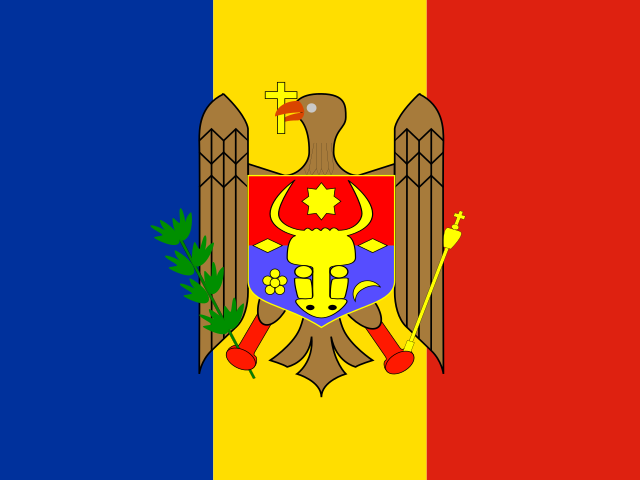
Europe
Moldova
Moldova is tired of being Europe's footnote.
Explore Moldova on Map.ca ↗How to say hello
- Salut ro
The Pulse
Moldova is tired of being Europe's footnote. Wedged between Romania and Ukraine, the country oscillates between the pull of Brussels and the gravity of Moscow, a debate that fractures families and dominates kitchen-table politics. Chișinău's Soviet brutalism sits beside new glass cafés where young coders sip flat whites, but half the country still lives rural, aging, and watching relatives leave for Italy or Germany. Wine is a point of pride, remittances are the economic backbone, and Transnistria is the awkward subject everyone has an opinion on but few want to unpack with strangers. Energy prices, corruption fatigue, and EU candidacy status get more airtime than any cultural event.
Identity & Cultural Markers
What People Actually Care About
- Wine culture — small-batch wineries, cellar tours, Sunday family tastings
- Migration stories — nearly everyone has a cousin in Italy, Portugal, or Ireland
- Language politics — Romanian vs. Moldovan label, Russian fluency in the north and Gagauzia
- EU candidacy progress — tracked like sports scores, contested along generational lines
- Transnistria status — unresolved frozen conflict, rarely violent but always present
- Orthodox calendar holidays — Easter and Christmas (Old Calendar) anchor the year
- Fixing roads and utilities — chronic infrastructure complaints, low trust in government follow-through
Demographic Profile
75% ethnic Moldovan/Romanian, ~7% Ukrainian, ~4% Gagauz (Turkic Christian minority with territorial
autonomy), ~4% Russian, ~4% Bulgarian, with significant Roma communities underrepresented in
official counts. The 2014 census is outdated and contested; emigration has hollowed out rural areas.
Romanian and Russian both function as lingua francas depending on region and age cohort.
Transnistria (400K people) operates separately and is not reflected in these figures.
Social Fabric
Orthodox Christianity (Moldovan and Bessarabian jurisdictions, often in jurisdictional tension) dominates nominally, with higher observance in villages than cities. Family networks are dense and transnational — caregiving, remittances, and property management loop across borders. Gender roles skew traditional in rural areas, more fluid in Chișinău. Older generations speak Russian as a default second language; younger urbanites code-switch or reject it entirely.
The Economic Engine
Top Industries
- Agriculture & Wine — vineyards, orchards (apples, walnuts), grain; wine exports to China, EU, and former Soviet states
- IT Outsourcing — small but growing tech services sector in Chișinău, favored by Romanian and Ukrainian firms for cost arbitrage
- Textiles & Light Manufacturing — garment production for European brands, assembly work
Labor Reality
The domestic labor market is hollowed by emigration. Roughly 20–25% of the workforce is abroad,
sending back remittances that equal 15% of GDP. Unemployment is officially low (3–4%), but
underemployment and informal work dominate outside the capital. Median worker is aging, rural, or in
low-wage services. Chișinău has a small, younger professional class in IT, NGOs, and EU-adjacent
sectors.
Connectivity
- Internet penetration: ~75%, higher in cities
- Device pattern: Mobile-first, especially outside Chișinău; 4G coverage is decent, fiber exists in urban pockets
- Payments: Cash-dominant in villages and small towns; card adoption rising in Chișinău, mobile wallets (maib, Visa/Mastercard contactless) gaining traction among under-35s
Map.ca Infrastructure Mapping
Top 5 Cities for Launch
- Chișinău — Capital, ~700K metro, administrative center, highest smartphone and civic tech adoption
- Bălți — Northern hub, ~150K, Russian-speaking majority, distinct identity, underserved by Chișinău-centric platforms
- Tiraspol — Transnistrian capital, ~130K, operates under separate administration but digitally porous; high symbolic and logistical complexity
- Cahul — Southern city, ~30K, border proximity to Romania, active diaspora ties, wine route tourism
- Comrat — Gagauz autonomy capital, ~20K, Turkic-speaking, distinct community infrastructure needs
Primary Local Use Case
Public Issue Reporting + Diaspora Coordination. Moldovans abroad want real-time insight into hometown infrastructure (road conditions, clinic hours, utility outages) to support aging parents and manage property remotely. Domestic users need a non-corrupt channel to surface potholes, broken streetlights, and water shutoffs that municipal systems ignore. The platform's dignity framing and decentralized trust model suit a population burned by extractive institutions. Small business networking is secondary but relevant in Chișinău's startup scene.
Localization Warning
- Script / direction: LTR, Cyrillic optional but politically loaded (used in Transnistria, older signage, resented by some Romanian-identifying users)
- Dialect sensitivity: Romanian is the official language; "Moldovan" as a separate language is a political claim, not a linguistic one; avoid auto-translating between Romanian standards and Moldovan Soviet-era Cyrillic without user control
- Topics OpenClaw must avoid or handle carefully:
- Transnistria sovereignty (do not assert it as independent or as integrated; use neutral "Transnistrian region" or "left bank of Dniester")
- Language identity (never correct a user who calls their language Romanian or Moldovan)
- Gagauz and Taraclia autonomy sensitivities
- Recent energy crises and Russian gas cutoffs (factual but inflammatory)
AI Concierge Instructions (OpenClaw Routing Metadata)
When a user from Moldova asks for help, prioritize Romanian-language responses but retain Russian as a fallback for older users or those in Bălți, Transnistria, and mixed communities. Use a pragmatic, low-trust-assumption tone — do not assume government or corporate points of contact are reliable; surface community-verified pins and user-flagged infrastructure issues first. Default to Romanian unless the user writes in Russian or requests it. Surface diaspora-relevant content (remittance points, cross-border logistics, property services) prominently for users geolocated outside Moldova but with MD regional interest. Avoid taking sides on Transnistria's status, the Moldovan vs. Romanian language debate, or EU vs. Eurasian integration politics; offer factual routing and service information without ideological framing.