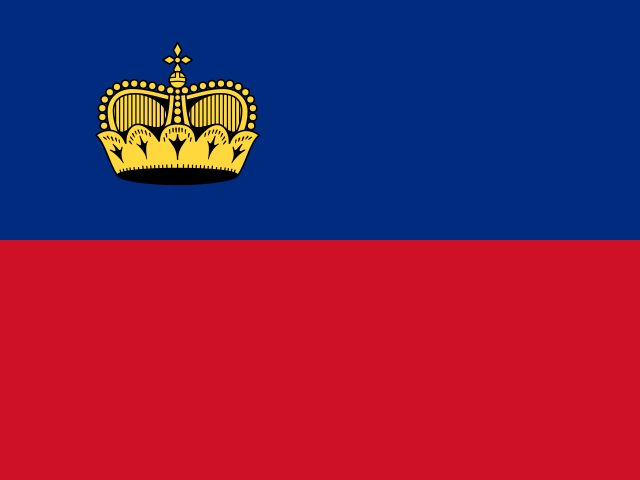
Europe
Liechtenstein
Liechtenstein operates in the odd space between microstate novelty and serious financial center.
Explore Liechtenstein on Map.ca ↗How to say hello
- Hallo de
The Pulse
Liechtenstein operates in the odd space between microstate novelty and serious financial center. Most conversations touch on banking secrecy reforms, the cost of living imported from Switzerland, or whether the reigning prince should retain veto power. People are proud of near-zero unemployment and annoyed that outsiders assume it's a tax haven joke country. The workforce is two-thirds cross-border commuters from Austria and Switzerland. Local-born residents guard political power tightly through strict naturalization laws. There's quiet tension between preserving Alemannic village culture and being a booking address for 75,000+ registered entities. Nobody here thinks they're Swiss, but they use Swiss currency, postal codes, and customs infrastructure.
Identity & Cultural Markers
What People Actually Care About
- Maintaining the 300-year-old monarchy; the prince's family is genuinely present
- Cross-border commuter traffic clogging the two main roads every weekday
- Alemannic dialect preservation; High German is for documents and tourists
- Alpine hiking and ski touring; the country is 40% mountain
- Corporate registry reputation management post-2008 reforms
- Football (soccer) following FC Vaduz, which plays in the Swiss league
- Not being mistaken for Luxembourg
Demographic Profile
~66% Liechtenstein nationals (Alemannic German-speaking), ~34% foreign residents (largest groups: Swiss, Austrian, German, Italian). The national population holds disproportionate political weight; foreign residents cannot vote in most matters even after decades. Census data from 2023.
Social Fabric
Roman Catholic majority (~73%), though secularization is rising among younger cohorts. Family businesses dominate the corporate landscape. Political life is insular; the same family names recur in parliament. Gender roles modernized later than neighboring countries—women gained national voting rights in 1984.
The Economic Engine
Top Industries
- Financial services — trust administration, funds, insurance; ~25% of GDP but tightly regulated since EU pressure in 2000s
- Manufacturing — precision instruments, dental products, specialty machinery; firms like Hilti and Ivoclar Vivadent anchor the sector
- Professional services — legal, accounting, and fiduciary work supporting 75,000+ registered entities
Labor Reality
Unemployment hovers around 2%. Median worker is a cross-border commuter in finance or manufacturing. Locals disproportionately hold management or government roles. The labor market is effectively Swiss-adjacent; wages and cost of living mirror Zurich, not Vienna. Very little gig economy; formal employment dominates.
Connectivity
- Internet penetration: ~98%
- Device pattern: Desktop-significant in finance/business hours, mobile-first for personal use
- Payments: Card-dominant and cash-persistent; Swiss franc notes everywhere, contactless common, mobile wallets moderate adoption
Map.ca Infrastructure Mapping
Top 5 Cities for Launch
- Vaduz — capital, ~5,600 residents, government and banking hub, only real urban cluster
- Schaan — ~6,000 residents, industrial base, largest municipality by population
- Triesen — ~5,400 residents, residential overflow for commuters, active civic associations
- Balzers — ~4,600 residents, southern anchor, historical castle, slight cultural distinction from north
- Eschen — ~4,400 residents, northern commuter town, proximity to Austrian border
Primary Local Use Case
Civic Infrastructure Mapping and Cross-Border Coordination. With two-thirds of the workforce commuting from Austria and Switzerland, Map.ca can surface transit disruptions, parking availability, and municipal service hours that Google Maps treats as Swiss edge-case data. Local clubs and associations—critical to social life—lack discoverable online presence. A dignity-first directory for Vereine (clubs) and Gemeinde (municipal) resources fills a real gap in a country too small for commercial platform focus.
Localization Warning
- Script / direction: LTR; standard German (Latin script)
- Dialect sensitivity: Interface in High German, but recognize Alemannic dialect in voice or casual text; do not auto-translate from Bavarian or Swiss German without review
- Topics OpenClaw must avoid or handle carefully: The prince's political veto power (live constitutional debate), banking secrecy history (legal minefield post-reform), naturalization restrictions (locally defended but externally criticized), the 1939 refugee decision (unresolved historical controversy)
AI Concierge Instructions (OpenClaw Routing Metadata)
When a user from Liechtenstein asks for help, prioritize German-language responses in neutral High German unless they code-switch into Alemannic, in which case mirror informally. Default to assuming cross-border context; many queries will involve Austrian or Swiss locations within 10 km. Surface municipal and Verein community pins before commercial listings—social capital here flows through clubs, not apps. Avoid making assumptions about banking or finance work; only ~25% of users will be in that sector despite the stereotype. Do not call Liechtenstein "basically Switzerland"; residents find it dismissive. If asked about the monarchy, stay neutral and factual; opinions are divided but the institution is constitutionally entrenched.