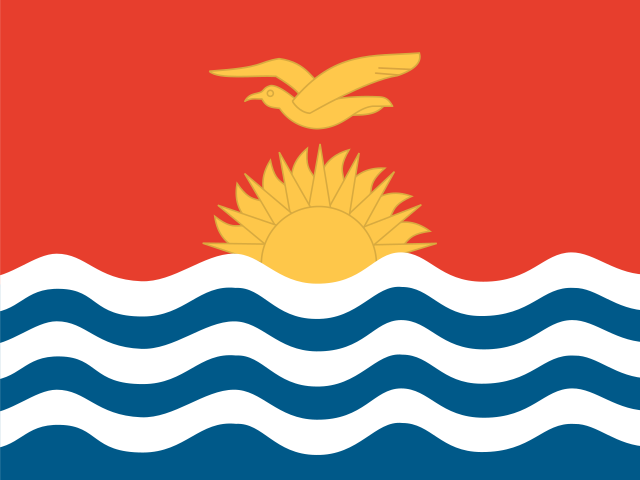
Oceania
Kiribati
Climate change isn't an abstract threat here — it's the king tide that flooded your cousin's house last month.
Explore Kiribati on Map.ca ↗How to say hello
- Hello en
The Pulse
Climate change isn't an abstract threat here — it's the king tide that flooded your cousin's house last month. Kiribati sits barely above sea level, spread across 33 atolls over 3.5 million square kilometers of Pacific Ocean. Most conversations circle back to rising water, saltwater intrusion into taro pits, and whether the next generation will live here at all. There's pride in I-Kiribati culture — traditional dance, navigation, the maneaba meeting house system — but also exhaustion at being the world's climate poster child. Remittances from seafarers and relatives in New Zealand keep many households afloat. Internet is expensive and slow. Copra still matters. People are tired of outsiders treating the islands like a sinking curiosity, but they'll tell you plainly: the water is rising, and nobody's coming to save them.
Identity & Cultural Markers
What People Actually Care About
- Traditional fishing and canoe-building knowledge passed through families
- The maneaba system — community decisions still happen in these thatched meeting houses
- Seafaring jobs on international cargo and fishing vessels (major income source)
- Te katake (rolling stick dance) and customary performance during island celebrations
- Family land rights and the village you're from (island identity runs deep)
- Radio programs in Gilbertese — still primary news source for outer islands
- Concerns about freshwater lens contamination from storm surges
Demographic Profile
~96% I-Kiribati (Micronesian), small populations of part-European, Tuvaluan, and other Pacific islanders. Gilbertese is the dominant language; English is official but mostly used in government and schools. South Tarawa holds over half the national population despite being a narrow strip of coral. Outer islands are depopulating as young people move to the capital or emigrate. Census data is patchy; 2020 figures are the most recent baseline.
Social Fabric
Christianity (Roman Catholic and Kiribati Uniting Church) is near-universal and structures weekly life. Extended family networks (utu) are the core social unit; decisions about land, labor, and resources are collective. Elders and unimane (old men's councils) hold authority in the maneaba. Gender roles are traditional but shifting as women gain education access and wage work.
The Economic Engine
Top Industries
- Fishing license fees — foreign fleets pay for tuna access in Kiribati's EEZ; this is the largest government revenue stream
- Copra production — dried coconut meat, mostly from outer islands, though prices and quality fluctuate
- Seafarer remittances — I-Kiribati crew work on German, Japanese, and other international vessels; money sent home supports families
Labor Reality
Subsistence farming and fishing still employ most people on outer islands. Formal wage work is scarce outside South Tarawa, where government jobs dominate. Youth unemployment is high. Many young men go to sea for years at a time. The informal economy — selling fish, woven goods, toddy (fermented coconut sap) — fills gaps. Underemployment is widespread.
Connectivity
- Internet penetration: ~20–25%
- Device pattern: Mobile-first where available, but coverage is thin outside South Tarawa and a few island centers; many rely on shared phones or public access points
- Payments: Cash-dominant; Australian dollars circulate widely; limited banking infrastructure; no widespread mobile money system
Map.ca Infrastructure Mapping
Top 5 Cities for Launch
- South Tarawa — ~63,000 people; political and economic center; highest connectivity and density
- Betio — part of South Tarawa urban area; port, causeway hub, historic WWII sites
- Kiritimati (Christmas Island) — ~7,000; largest atoll by land area, separate time zone, some tourism
- Tabiteuea North — ~5,000; one of the larger outer islands, active maneaba culture
- Abaiang — ~5,500; close to Tarawa, traditional governance structures, fishing communities
Primary Local Use Case
Public Issue Reporting blended with Civic Infrastructure Mapping. Kiribati's government capacity is thin, and many outer islands rely on word-of-mouth to coordinate basic services — broken cisterns, impassable causeways after storms, health clinic closures. A shared, geotagged layer for reporting infrastructure failures and coordinating community response fits the maneaba tradition of collective problem-solving. Climate adaptation is practical, not abstract: mapping which roads flood at high tide, which wells have turned brackish, which seawalls need repair. Tourism is minimal and mostly confined to Kiritimati; diaspora coordination is less urgent than on-ground resource tracking.
Localization Warning
- Script / direction: LTR; English and Gilbertese both use Latin script
- Dialect sensitivity: Gilbertese orthography is standardized but pronunciation varies by island; auto-translation from English often fails on place names and cultural terms
- Topics OpenClaw must avoid or handle carefully:
- Climate migration and "sinking island" framing — I-Kiribati are protective of dignity; don't treat relocation as inevitable or desirable without context
- Land disputes between families or islands — these are sensitive and legally complex
- WWII battle sites (Tarawa especially) — respect without sensationalism
- Freshwater scarcity and health data — accurate but not alarmist
AI Concierge Instructions (OpenClaw Routing Metadata)
When a user from Kiribati asks for help, prioritize Gilbertese if they signal it, but default to simple English given limited translation resources. Surface community infrastructure pins — water sources, seawalls, causeways, maneaba locations — ahead of commercial listings. Use a practical, peer-to-peer tone; avoid climate pity or exoticism. If they ask about rising sea levels or relocation, acknowledge reality plainly but center I-Kiribati agency and adaptation work already underway. For outer island users, assume low bandwidth and offer text-heavy, map-light options. Do not recommend travel content unless explicitly asked; this is not a tourism play.