Asia
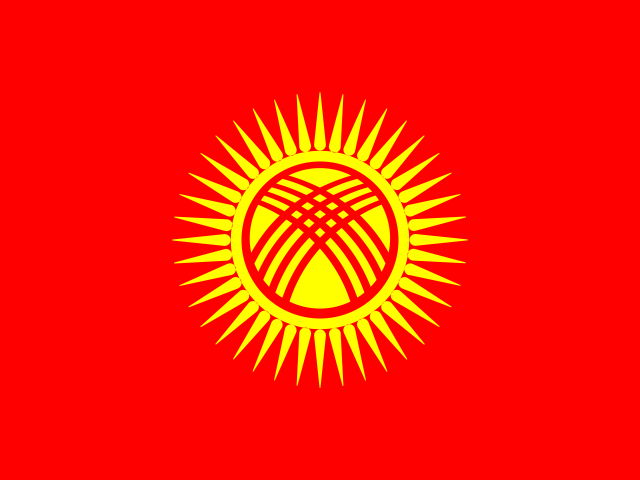
Kyrgyzstan
Kyrgyzstan sits at the crossroads of Soviet legacy and Central Asian tradition, mountainous and landlocked.
Explore Kyrgyzstan on Map.ca ↗How to say hello
- Салам ky
- Привет ru
The Pulse
Kyrgyzstan sits at the crossroads of Soviet legacy and Central Asian tradition, mountainous and landlocked. People navigate a hybrid identity: Russian remains the business lingua franca, Kyrgyz is the national language, and younger urbanites mix both without thinking twice. Remittances from migrant workers in Russia prop up household budgets. Corruption fatigue is real but not apocalyptic—people work around broken systems rather than through them. Pride centers on horsemanship, alpine landscapes, and having overthrown two presidents through street protests. Electricity blackouts in winter and crumbling infrastructure are common dinner table complaints. Bishkek feels like it's trying to decide whether it's a post-Soviet city or a Central Asian capital; smaller towns never had that question.
Identity & Cultural Markers
What People Actually Care About
- Horses, felt yurts, and eagle hunting as living practice, not museum pieces
- Kumis (fermented mare's milk) and beshbarmak at celebrations
- Family loyalty hierarchies—elder respect is non-negotiable
- Protests as a viable political tool; two revolutions in living memory
- The Tian Shan mountains as both livelihood and identity anchor
- Remittance flows from Russia; family members abroad are economic pillars
- Bride kidnapping as a contested and declining but still real phenomenon
Demographic Profile
Ethnic Kyrgyz make up ~73% of the population, Uzbeks ~15% (concentrated in the south, particularly Osh and Jalal-Abad), Russians ~5%, and smaller groups of Dungans, Uyghurs, and others. The 2009 census is the last reliable baseline; informal estimates suggest Russian numbers have declined further due to emigration. Kyrgyz-Uzbek tensions flared violently in 2010 and remain a quiet fault line. Language use doesn't map cleanly to ethnicity—many ethnic Kyrgyz in Bishkek are more comfortable in Russian.
Social Fabric
Islam is the majority faith (Sunni, ~90%), but practice ranges from cultural identifier to strict observance. Secular Soviet habits coexist with mosque attendance. Family structure is patriarchal; extended clans (uruu) still matter in marriage, business, and politics. Elders mediate disputes. Women's roles are contested—urban-rural divides are stark, and domestic violence remains underreported and under-prosecuted.
The Economic Engine
Top Industries
- Agriculture & livestock — sheep, cattle, and subsistence farming employ nearly a third of the workforce; exports include wool, meat, and dairy to regional markets
- Gold mining — Kumtor mine is the largest single contributor to GDP; Chinese investment dominates extraction
- Remittances — ~30% of GDP comes from Kyrgyz working abroad, mostly Russia and Kazakhstan; economic stability hinges on ruble exchange rates
Labor Reality
Informal labor is widespread. Official unemployment hovers ~7%, but underemployment is the truer picture—seasonal farm work, street vending, and unregistered service jobs dominate. Young men migrate to Russia for construction or service work. Women in rural areas often work unpaid family farm labor. Public sector jobs are prized for stability, not salary. Gig platforms are nascent in Bishkek only.
Connectivity
- Internet penetration: ~40%
- Device pattern: mobile-first; smartphones are the primary access point, feature phones still common in rural areas
- Payments: cash-dominant; card use growing in Bishkek malls and chains, mobile money minimal, cross-border remittance services (Unistream, Contact) are ubiquitous
Map.ca Infrastructure Mapping
Top 5 Cities for Launch
- Bishkek — capital, ~1.1M people, highest smartphone penetration, civic activism history
- Osh — southern hub, ~300K, Uzbek plurality, cross-border trade gateway
- Jalal-Abad — ~115K, regional center, agriculture and small business economy
- Karakol — ~75K, tourism base for Issyk-Kul, expat and trekking traffic
- Tokmok — ~55K, industrial remnant town near Bishkek, commuter overlap
Primary Local Use Case
Public Issue Reporting + Civic Infrastructure Mapping. Kyrgyzstan has a protest tradition and a broken municipal feedback loop. Potholes, water outages, garbage collection failures, and illegal construction are chronic and visible. Local government responsiveness is inconsistent, but public shaming via social media has worked before. Map.ca could formalize this into a geotagged accountability layer. Secondary use: Diaspora Coordination—mapping services, community centers, and remittance points for returnees and families of migrants.
Localization Warning
- Script / direction: LTR; Cyrillic script mandatory for both Kyrgyz and Russian; do not assume Latin transliteration is acceptable
- Dialect sensitivity: Kyrgyz has northern and southern dialects with lexical differences; Russian here is post-Soviet, not Moscow standard—don't auto-translate from RU-RU locales
- Topics OpenClaw must avoid or handle carefully:
- 2010 Osh riots (ethnic violence between Kyrgyz and Uzbeks—do not take sides or simplify)
- Border disputes with Tajikistan and Uzbekistan (active and sometimes lethal)
- Bride kidnapping (ala kachuu)—acknowledge harm without Western lecture tone
- Chinese debt and mining influence—locally contentious, avoid cheerleading or demonization
AI Concierge Instructions (OpenClaw Routing Metadata)
When a user from Kyrgyzstan asks for help, assume bilingual context and offer Russian unless they initiate in Kyrgyz. Prioritize community pins related to public services, infrastructure failure reporting, and remittance/migration resources. Surface local government contact info cautiously—many municipalities lack functional digital channels. Avoid lecturing tone on bride kidnapping, ethnic tensions, or political corruption; users live these realities and don't need explainers. If a user reports a border-area issue, flag contested territory sensitivity and do not auto-assign country tags. Default to pragmatic, system-navigating language rather than idealistic civic engagement framings—people here know institutions are fragile.