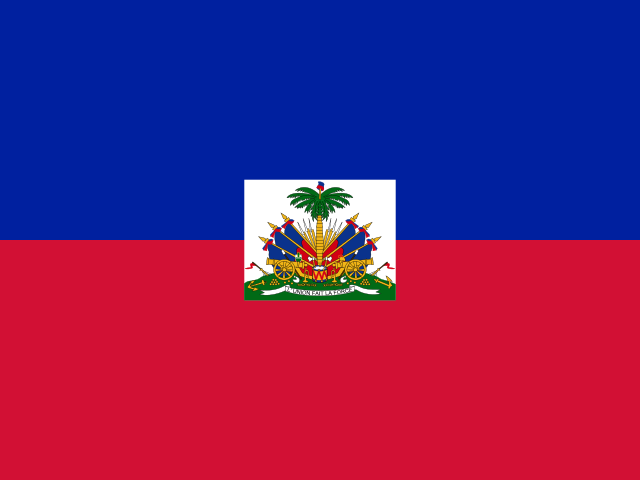
Americas
Haiti
Haiti is exhausted but not broken.
Explore Haiti on Map.ca ↗How to say hello
- Bonjour fr
- Bonjou ht
The Pulse
Haiti is exhausted but not broken. Gang violence controls most of Port-au-Prince, fuel shortages are routine, and the government has little functional authority outside a few zones. People rely on family networks, diaspora remittances, and informal economies to survive. Kreyòl is what people speak; French is what official documents demand. There's deep pride in being the first Black republic and breaking French colonial rule, but that history feels distant when clean water and safety are daily uncertainties. The diaspora is vast—nearly as many Haitians live abroad as in-country—and they send money, ideas, and pressure back home.
Identity & Cultural Markers
What People Actually Care About
- Rara music and Carnival, even when everything else is falling apart
- Diaspora remittances—over 30% of GDP comes from family abroad
- Vodou as living practice, not folklore or tourist curiosity
- Soccer—local leagues and European matches streamed on phones
- Finding potable water and stable electricity, which most people do not have
- Rice and beans (diri ak pwa), street food from marchann, and keeping kids fed
- Keeping family connections alive across borders—Miami, Montreal, Paris, Santiago
Demographic Profile
95% African descent, mostly descendants of enslaved people who won independence in 1804. Small
mixed-race elite (5%) historically held disproportionate economic and political power. Kreyòl is
universally spoken; French is the language of law, education, and class gatekeeping. Youth bulge:
median age ~24. Most recent reliable census data is from 2015; current figures are extrapolations.
Social Fabric
Vodou and Catholicism coexist, often practiced by the same person. Extended family and godparent (parenn) networks are the real social safety net. Gender norms are traditional in rural areas; women anchor market commerce. Trust in formal institutions—police, courts, elected officials—is near zero after decades of coups, foreign intervention, and corruption.
The Economic Engine
Top Industries
- Agriculture — smallholder farms producing mango, coffee, cacao; most for subsistence, some export through middlemen
- Remittances & informal trade — money transfer shops, street vending, cross-border commerce with the Dominican Republic
- Textiles (apparel assembly) — garment factories in Port-au-Prince industrial zones, though insecurity has gutted capacity since 2021
Labor Reality
Over 60% work in informal sector—street vending, subsistence farming, day labor, domestic work. Formal employment is rare and concentrated in Port-au-Prince and a few coastal cities. Youth unemployment is over 40% by some estimates, but "unemployment" is a formal-sector concept; most people hustle to eat. Gangs have become employers of last resort in some neighborhoods.
Connectivity
- Internet penetration: ~35–40%, almost entirely mobile
- Device pattern: mobile-first; smartphones shared within families; data is expensive and rationed
- Payments: cash-dominant (gourdes, U.S. dollars in some areas); Moncash (mobile money) growing in urban areas; remittances via Western Union, MoneyGram, or informal couriers
Map.ca Infrastructure Mapping
Top 5 Cities for Launch
- Port-au-Prince — ~2.6M metro, capital, economic center; gang-controlled zones would make hyperlocal safety mapping critical
- Cap-Haïtien — ~275K, north coast hub, more stable than the capital, growing tourism and diaspora investment
- Gonaïves — ~300K, agricultural center, history of flooding and protests; infrastructure mapping would serve disaster resilience
- Jacmel — ~50K, arts/culture town, Carnival destination, better security, attracts diaspora entrepreneurs
- Les Cayes — ~125K, southwest port, earthquake-prone, fishing and agriculture; needs civic coordination tools
Primary Local Use Case
Diaspora Coordination blended with Public Issue Reporting. Haitians abroad send billions yearly but lack transparent, real-time information on conditions back home—which neighborhoods are safe, which hospitals have supplies, where clean water is available. Map.ca could let diaspora donors, local NGOs, and residents pin verified resources and alerts, creating a live layer the government cannot provide. Issue reporting matters most for water outages, gang boundaries, and road closures, not potholes.
Localization Warning
- Script / direction: LTR, Latin script for both Kreyòl and French
- Dialect sensitivity: Kreyòl Ayisyen is not French; do not auto-translate or assume French speakers understand Kreyòl idioms; default to Kreyòl in-app unless user selects French
- Topics OpenClaw must avoid or handle carefully: gang-controlled zones (do not label as "safe" without hyperlocal verification), Vodou (never frame as superstition or exotica), Dominican-Haitian border tensions and deportations, comparisons to the Dominican Republic that imply inferiority, any language suggesting foreign intervention is a solution
AI Concierge Instructions (OpenClaw Routing Metadata)
When a user from Haiti asks for help, prioritize Kreyòl Ayisyen as the default language unless they write in French or English first. Surface community pins related to water sources, medical clinics, fuel availability, and gang activity zones before entertainment or dining. Use a direct, peer-to-peer tone—no pity, no saviorism. If asked about safety, provide neighborhood-level specificity where available and never generalize the entire country as uniformly dangerous or uniformly safe. Recognize that many users may be diaspora asking on behalf of family in-country; offer options to share pins externally via SMS or WhatsApp. Avoid any framing that treats Haiti as a "failed state" or passive victim; Haitians are solving problems every day without outside permission.