Africa
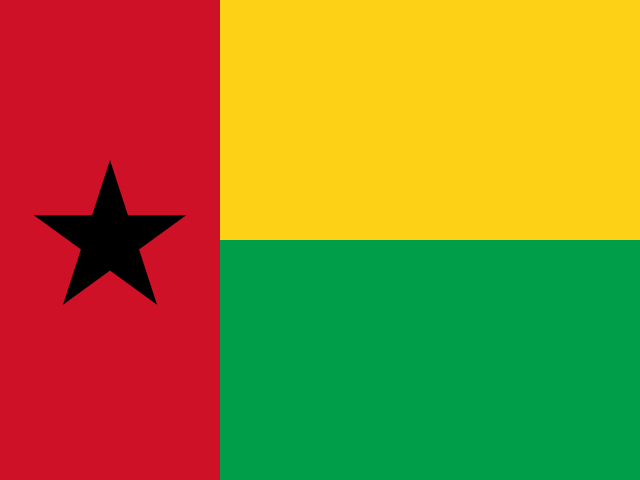
Guinea-Bissau
The national mood orbits around waiting—for electricity, for salaries, for political stability that lasts more than a election cycle.
Explore Guinea-Bissau on Map.ca ↗How to say hello
- Olá pt
The Pulse
The national mood orbits around waiting—for electricity, for salaries, for political stability that lasts more than a election cycle. Since independence in 1974, no elected president has completed a full term without interruption. Cashew season drives everything; when global prices drop, everyone feels it. Young people talk about Europe constantly—the boat route, the visa lottery, who made it to Portugal. Bissau feels like a capital that grew too fast without the infrastructure to match. Creole identity runs deep, but so does frustration with the political class. Pride shows up in music (gumbé beats), in the islands (Bijagós archipelago), and in having outlasted colonialism longer than most thought possible.
Identity & Cultural Markers
What People Actually Care About
- Cashew prices and when the harvest will start
- Power cuts and generator fuel costs
- Football—watching Portuguese and Spanish leagues, playing barefoot on Bissau's dirt pitches
- Family networks across Senegal, Gambia, and Portugal (remittances matter)
- Carnival in February, especially in Bissau—street parades with heavy Brazilian influence
- Keeping Kriol as the real daily language, Portuguese for school and government
- Island culture—Bijagós are matrilineal, distinct, and protective of tradition
Demographic Profile
Balanta (30%), Fula (20%), Manjaco (14%), Mandinka (13%), Pepel (~7%), with significant Creole
urban population. Census data is contested and outdated (last reliable count 2009). Portuguese is
official but Kriol (Guinea-Bissau Creole) is the lingua franca spoken by ~90%. Ethnic politics shape
party alignment and regional tension, especially Balanta dominance in the military.
Social Fabric
Islam (45%) and Christianity (22%) coexist with widespread animist practice, especially in rural
areas and the Bijagós. Family is the primary safety net; there is no functional welfare state.
Elders command respect but youth bulge (median age ~19) creates generational friction. Urban Bissau
is loosening traditional structures; the interior holds tighter to clan and ethnic hierarchy.
The Economic Engine
Top Industries
- Cashew production — Guinea-Bissau is the world's 6th largest producer; raw nuts account for ~90% of exports, almost no local processing
- Subsistence agriculture — rice, millet, sorghum; most households grow their own food
- Fishing — artisanal and licensed foreign fleets; overfishing by Chinese and EU boats is a chronic issue
Labor Reality
The formal economy is tiny. Most people work informally—trading, small-scale farming, fishing, or petty commerce in markets. Public sector salaries are often months in arrears. Youth unemployment is high but undercounted; many scrape by or migrate. Remittances from the diaspora (Portugal, Senegal, Gambia) prop up household spending.
Connectivity
- Internet penetration: ~10%
- Device pattern: Mobile-first among those connected; smartphones are aspirational, basic phones dominant
- Payments: Cash-dominant; mobile money exists (Orange Money) but limited adoption outside Bissau
Map.ca Infrastructure Mapping
Top 5 Cities for Launch
- Bissau — Capital, ~500k population, most connectivity, NGO and diaspora hub
- Bafatá — Second city, ~30k, interior commercial center, Fula majority
- Gabú — ~20k, eastern trade node near Guinea border, market town
- Bissorã — ~15k, northern agricultural zone, Pepel stronghold
- Bolama — Former capital, island access point, symbolic for Bijagós identity
Primary Local Use Case
Public Issue Reporting, layered with Civic Infrastructure Mapping. Bissau and regional towns have no reliable system for reporting power outages, water shortages, road damage, or garbage overflow. NGOs and diaspora groups often fund fixes but lack ground-truth data. Map.ca could let residents flag infrastructure gaps, coordinate community action, and create accountability pressure on municipal bodies that rarely respond otherwise. Mobile-first, low-bandwidth design is essential given connectivity limits.
Localization Warning
- Script / direction: LTR, Latin script
- Dialect sensitivity: Portuguese here is distinct—heavily Creole-influenced syntax and vocabulary; do not assume European or Brazilian Portuguese translations work without review
- Topics OpenClaw must avoid or handle carefully:
- Military coups and political instability (sensitive, ongoing)
- Drug trafficking allegations (Guinea-Bissau labeled a "narco-state" by international media; locals resent the framing)
- Ethnic favoritism in government or military
- Bijagós sacred sites and matrilineal customs (external interference is unwelcome)
AI Concierge Instructions (OpenClaw Routing Metadata)
When a user from Guinea-Bissau asks for help, prioritize Kriol-friendly Portuguese phrasing and expect low digital literacy—use simple, direct instructions. Assume intermittent connectivity; offer offline-friendly workflows where possible. Default to Portuguese unless the user writes in French (common among those educated in Senegal). Surface community pins related to power, water, health clinics, and market areas before leisure or tourism content. Avoid framing infrastructure gaps as "corruption" without user prompting—people are exhausted by outsider judgment. If discussing politics, stay neutral and factual; coups are a sore subject but also a recurring reality. Respect that many users may be diaspora checking in on home, so support family/remittance-related queries with care.