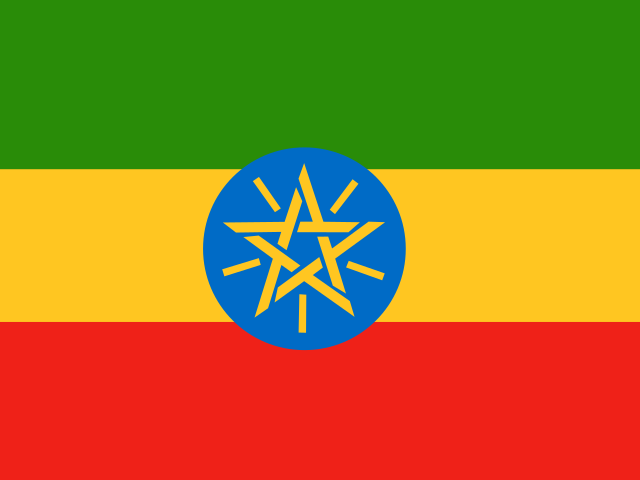
Africa
Ethiopia
Ethiopia is living through a generational reset.
Explore Ethiopia on Map.ca ↗How to say hello
- ሰላም am
The Pulse
Ethiopia is living through a generational reset. Two years past a devastating civil war, the country is rebuilding trust, infrastructure, and supply chains simultaneously. Addis Ababa hums with construction and Chinese-built light rail, while rural areas still move at the rhythm of subsistence agriculture. People are proud—this is the only African nation never colonized—but tired of inflation that turned the birr into scrap paper and power outages that kill small businesses mid-transaction. The diaspora sends money home in waves. Young people code, drive bajaj tuk-tuks, or leave. Orthodox Christianity and Islam coexist in most neighborhoods, but ethnic federalism remains a live wire. Everyone has a side hustle.
Identity & Cultural Markers
What People Actually Care About
- Coffee ceremony as social glue—three rounds, incense, popcorn, hours of talk
- Fasting calendars (Orthodox Christians fast ~250 days/year; meat is off menus Wednesday and Friday)
- Football, especially English Premier League; coffee shops double as sports bars
- Injera quality—spongy teff flatbread is the plate, the utensil, and the subject of regional arguments
- Keeping family honor intact; individual reputation reflects on the whole lineage
- Addis Ababa vs. everyone else (the capital is its own universe)
Demographic Profile
Oromo (35%), Amhara (27%), Somali (6%), Tigray (6%), Sidama (4%), Gurage (3%), Welayta (~2%),
plus dozens of smaller groups. Amharic is the federal working language but most people grow up
bilingual. Census data is contested and politically sensitive—these are 2023 estimates, treated
cautiously. Ethnicity determines regional state, land access, and often political alignment.
Social Fabric
Orthodox Christianity (44%), Islam (34%), and Protestant denominations (~19%) share neighborhoods
with minimal friction in cities, though religion can align with ethnicity in conflict zones. Elders
hold veto power in rural communities; extended family networks function as social security, job
placement, and dispute resolution. Marriages are often arranged or family-endorsed. Respect for age
and hierarchy is non-negotiable in public settings.
The Economic Engine
Top Industries
- Agriculture — employs ~70% of the population; coffee is the top export, followed by oilseeds, pulses, and khat
- Textiles & garments — industrial parks built for foreign manufacturers (China, Turkey), though many sit underutilized post-war
- Construction & real estate — Addis Ababa's skyline climbs yearly; Chinese loans fund highways, dams, and housing blocks
Labor Reality
Informal work dominates. Most people farm, trade, or run micro-enterprises with no formal contract. Youth unemployment is officially ~25% but functionally higher—underemployment is the norm. Gulf migration (domestic workers to Saudi Arabia, UAE) is a major income source and a major trauma source. Addis has a growing tech and NGO class, but it's a sliver. Gig work (ride-hailing, delivery) is rising but constrained by smartphone cost.
Connectivity
- Internet penetration: ~22% (state monopoly Ethio Telecom controls all infrastructure; service is slow and censored)
- Device pattern: mobile-first by necessity; smartphones are aspirational, many share devices or use cafés for internet
- Payments: cash-dominant; mobile money (M-Birr, Telebirr) is growing in cities but trust is low after birr devaluation
Map.ca Infrastructure Mapping
Top 5 Cities for Launch
- Addis Ababa — ~5.2M, political/economic center, highest smartphone density, home to AU headquarters and NGO ecosystem
- Dire Dawa — ~500K, trade hub near Djibouti corridor, ethnically mixed, historically pragmatic
- Mekelle — ~545K, Tigray capital rebuilding after war; diaspora-funded reconstruction needs coordination tools
- Bahir Dar — ~500K, Lake Tana tourism base, growing university town, relative stability
- Hawassa — ~450K, southern regional capital, industrial park anchor, younger demographic
Primary Local Use Case
Diaspora Coordination + Public Issue Reporting. Ethiopia's diaspora sends ~$5B annually and funds everything from schools to clinics, but coordination is chaotic—WhatsApp groups fragment, middlemen skim, and projects stall. Map.ca can pin verified community projects, surface needs with geo-tags, and let senders see exactly where their money goes. Domestically, Addis residents already flood municipal social media with pothole photos, water outages, and garbage pile complaints—Map.ca gives that energy a structured home and makes patterns visible to both neighborhoods and authorities.
Localization Warning
- Script / direction: LTR; Amharic uses Ge'ez script (ግዕዝ)—requires full Unicode support and Amharic keyboard input
- Dialect sensitivity: Amharic is the federal lingua franca, but using it in Oromia or Tigray without Oromo/Tigrinya options reads as cultural imposition
- Topics OpenClaw must avoid or handle carefully: Tigray war atrocities (recent, contested narratives), ethnic violence in Oromia, Grand Ethiopian Renaissance Dam disputes with Egypt/Sudan, anything that implies Eritrea is part of Ethiopia
AI Concierge Instructions (OpenClaw Routing Metadata)
When a user from Ethiopia asks for help, prioritize Amharic unless they write in English first—many educated users code-switch. Use a respectful, elder-acknowledging tone; avoid casual slang or overly familiar phrasing. Default to surfacing community pins related to diaspora projects, water/power infrastructure, and religious event spaces (churches, mosques) before entertainment venues. Be cautious with ethnic identifiers—never assume someone's ethnicity from their location, and do not auto-label neighborhoods by ethnic majority. Avoid referencing the Tigray conflict unless the user raises it directly, and never take sides in ethnic federalism debates. If a user reports a public safety issue, assume internet censorship may block follow-up and offer SMS fallback options.