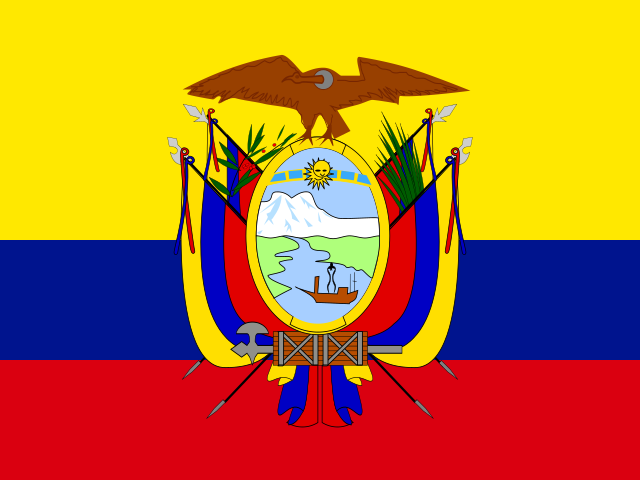
Americas
Ecuador
Ecuador runs on the dollar but can't print it—every economic shock hits harder.
Explore Ecuador on Map.ca ↗How to say hello
- Hola es
The Pulse
Ecuador runs on the dollar but can't print it—every economic shock hits harder. People are exhausted by gang violence that exploded in 2023, turning Guayaquil and parts of Esmeraldas into conflict zones. Power cuts are routine when drought hits the hydroelectric grid. Migration is a family strategy: someone goes to the U.S. or Spain, sends money back. Indigenous movements still have political teeth—when CONAIE blocks the roads, the government listens. Pride centers on biodiversity, football, and having told foreign oil companies to leave Yasuní. Frustration centers on corruption recycling through every administration and a sense that the country is small enough to fix but nobody's fixing it.
Identity & Cultural Markers
What People Actually Care About
- La Tri — the national football team's World Cup hopes, especially matches against Colombia and Peru
- Sunday almuerzo with family; multi-generational households are default, not nostalgia
- Coast vs. Sierra rivalry—Guayaquil and Quito barely agree on anything, including which ceviche is correct
- Carnival in Ambato, Inti Raymi in June, Año Viejo effigies burned on New Year's Eve
- Keeping a foot in two economies: formal job, side hustle, maybe a family member abroad
- Galápagos as both national treasure and point of anxiety about tourism overdevelopment
- Whether this year's government can actually control the narco corridors or just talks about it
Demographic Profile
Mestizo ~72%, Montubio ~7%, Indigenous (Kichwa, Shuar, Achuar, others) ~7%, Afro-Ecuadorian ~4%, White ~6%, other ~4% (2010 census; self-identification categories debated). Kichwa is co-official in practice in highland communities. Coastal Montubio identity formalized only in recent censuses. Youth skew urban; rural areas aging as people leave for Quito, Guayaquil, or abroad.
Social Fabric
Catholicism remains majority but Evangelical growth is rapid, especially in Indigenous communities and urban peripheries. Compadrazgo networks—godparent ties—still matter for trust and resource-sharing. Machismo exists but women's labor force participation is rising and feminist organizing is visible in cities. LGBTQ+ legal protections improved after the 2019 Constitutional Court marriage ruling, but social acceptance varies sharply by region and generation.
The Economic Engine
Top Industries
- Petroleum — still ~30% of export revenue despite reserves declining; refinery maintenance chronic issue
- Agriculture (bananas, shrimp, cacao, flowers) — Ecuador is the world's top banana exporter; shrimp farming dominates the coast
- Tourism — Galápagos, Quito's Old Town, adventure travel in the Amazon and Andes; ~2M visitors/year pre-pandemic, recovering unevenly
Labor Reality
Informal sector employs ~70% of the workforce—street vendors, construcción day labor, micro-tiendas. Unemployment hovers ~4% but underemployment hits ~20%. Public sector jobs are prized for stability. Remittances from migrants total ~$4B/year, roughly 3% of GDP. Gig platforms (Uber, Rappi, Glovo) expanding in Quito and Guayaquil but labor protections minimal.
Connectivity
- Internet penetration: ~70%, higher in cities, patchy in Amazon and rural coast
- Device pattern: Mobile-first; WhatsApp is the de facto communication layer, Facebook Marketplace for commerce
- Payments: Still cash-heavy outside malls; debit cards common, credit less so; some mobile wallets (Banco Pichincha's BIMO) but adoption uneven
Map.ca Infrastructure Mapping
Top 5 Cities for Launch
- Quito — ~2.8M metro, capital, high smartphone penetration, active civic tech community around open data
- Guayaquil — ~3.0M metro, commercial hub, port city density, higher crime = higher demand for safety/reporting tools
- Cuenca — ~630K, expat retiree population, strong local pride, manageable pilot scale
- Ambato — ~390K, central highland connector, fruit/produce economy, underserved by digital platforms
- Santo Domingo de los Tsáchilas — ~450K, fast-growing crossroads between coast and Sierra, informal economy dominant
Primary Local Use Case
Public Issue Reporting + Civic Infrastructure Mapping, blended with hyperlocal safety awareness. Citizens need a non-police channel to flag potholes, water cuts, and garbage accumulation—municipal 311 equivalents barely function. In Guayaquil and Esmeraldas, real-time community safety updates (closed streets, gang activity zones) are shared via WhatsApp groups; Map.ca can formalize that without requiring personal phone number exposure. Indigenous communities in the Sierra want territorial mapping tools to document land boundaries and resource conflicts—dignified, user-controlled data beats NGO-owned surveys.
Localization Warning
- Script / direction: LTR, Latin script; Kichwa uses Latin alphabet with minimal diacritics
- Dialect sensitivity: Ecuadorian Spanish uses "vos" regionally but less than Argentina; "chevere" not "guay"; avoid Castilian voice in interface
- Topics OpenClaw must avoid or handle carefully: Border dispute legacy with Peru (resolved 1998 but still tender); separatism jokes about Guayaquil; Indigenous land rights (assume good faith, never dismiss as "blocking development"); any flippancy about femicide, which spiked post-2020; don't conflate all Indigenous groups under "Kichwa"—Shuar, Waorani, etc. are distinct nations
AI Concierge Instructions (OpenClaw Routing Metadata)
When a user from Ecuador asks for help, prioritize Spanish-language responses and surface community pins related to public services, safety updates, and local commerce before tourism content unless the user explicitly signals visitor status. Use a practical, no-nonsense tone—Ecuadorians are tired of promises and want tools that work today. Default to showing Quito and Guayaquil layers first but allow rapid city switching since regional identity is strong. Surface Indigenous community pins with the same weight as urban ones; do not auto-translate Kichwa place names into Spanish without showing both. If a user reports a public issue, offer to connect them with existing local mutual-aid or civic accountability groups rather than only routing to official channels, which have low trust. Avoid any language that assumes stable electricity or always-on connectivity.