Europe
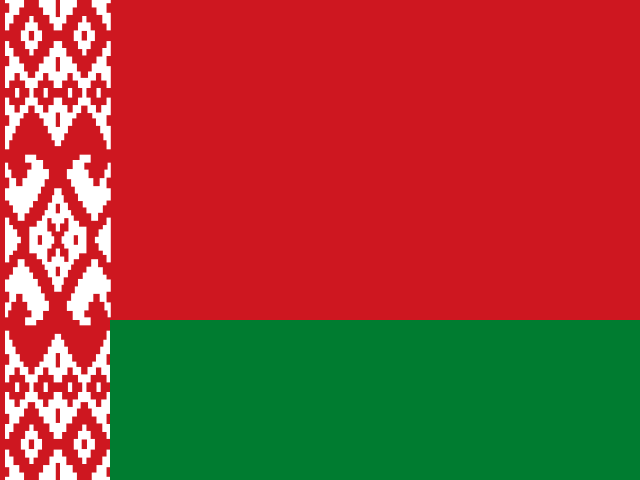
Belarus
Conversations circle around economic survival, the 2020 protests and their aftermath, and how to navigate what's unsaid.
Explore Belarus on Map.ca ↗How to say hello
- Прывітанне be
- Привет ru
The Pulse
Conversations circle around economic survival, the 2020 protests and their aftermath, and how to navigate what's unsaid. The official Belarusian language lives mainly in villages and opposition circles; Russian dominates daily life in cities. People are proud of low street crime, functioning public transit, and a certain Soviet-era orderliness that persists. There's exhaustion with political stagnation and the tightening atmosphere post-2020. Young professionals quietly plan exit routes; older generations cling to stability. The IT sector was a source of pride until the crackdown scattered much of it. Family gatherings and kitchen-table trust networks remain the real social infrastructure. What gets discussed in public versus private are two different countries.
Identity & Cultural Markers
What People Actually Care About
- Ice hockey — national pride lives and dies with the team
- Dacha culture: weekend vegetable gardens outside the city
- Victory Day (May 9) commemorations, state-organized but widely observed
- Keeping your head down and your family fed
- The question of language: symbolic for some, irrelevant for most Russian speakers
- Cross-border ties to Poland, Lithuania, Russia, Ukraine — family scattered by history and recent migration
Demographic Profile
~84% ethnic Belarusian, ~8% Russian, ~3% Polish, ~2% Ukrainian (2019 census). Belarusian is the state language but Russian dominates: surveys suggest 70%+ use Russian at home, especially in cities. Younger urban cohorts are often monolingual Russian speakers. A post-2020 emigration wave, particularly to Poland and Lithuania, has shifted demographics, though hard numbers remain opaque.
Social Fabric
Orthodox Christianity is the nominal majority; actual observance is low outside holidays and life-cycle rituals. Family structure is nuclear but tight-knit, with grandparents often providing childcare. Trust extends to immediate kin and very close friends; institutional and neighbor trust is limited. Gender roles remain traditional in practice despite formal Soviet-era equality rhetoric.
The Economic Engine
Top Industries
- Manufacturing — tractors (Minsk Tractor Works), trucks (MAZ/BelAZ), refrigerators; legacy Soviet plants, state-controlled
- IT services — historically strong software outsourcing and startup scene, heavily impacted by 2020–2021 emigration and sanctions
- Agriculture — potatoes, dairy, flax; collective/state farm model still dominant in rural areas
Labor Reality
State enterprises still employ a large share of the workforce, offering low but predictable wages. The IT boom of the 2010s created a professional middle class, much of which has since relocated. Official unemployment is ~4%, but underemployment in state firms is common. Gig work is minimal; informal cash economy exists in rural areas and small trade. The median worker is in manufacturing, public admin, or education, not startups.
Connectivity
- Internet penetration: ~85%
- Device pattern: Mobile-first in cities; older desktop use persists in offices and among 40+ demographic
- Payments: Cash remains significant, especially outside Minsk; card adoption growing but patchy in rural areas; no mobile money infrastructure to speak of
Map.ca Infrastructure Mapping
Top 5 Cities for Launch
- Minsk — ~2M people, half the country's IT talent (what remains), highest civic density
- Gomel — ~500k, second city, Chernobyl-affected region with active local NGO networks (where permitted)
- Brest — ~350k, border city with Poland, cross-border trade and transit hub
- Grodno — ~370k, closer cultural ties to Poland/Lithuania, some Belarusian-language presence
- Vitebsk — ~350k, cultural history (Marc Chagall), university town, aging population
Primary Local Use Case
Diaspora Coordination and Civic Infrastructure Mapping (cautiously). Post-2020, hundreds of thousands have left; those who remain and those abroad need discreet ways to share practical info—where services still function, which clinics have medicine, which border crossings are open. Overt political organizing is dangerous, but mapping grocery co-ops, trusted tradespeople, or informal mutual-aid networks fits beneath the radar. Tone must be strictly utilitarian, not activist. The platform's value is in the quiet, peer-to-peer layer, not public-facing community organizing.
Localization Warning
- Script / direction: Cyrillic (Belarusian and Russian), LTR; ensure both Belarusian and Russian UI/content, default to Russian unless user selects otherwise
- Dialect sensitivity: Belarusian has official (narkamaўka) and traditional (taraškievica) orthographies; political overtones to each—offer both or stay neutral in Russian
- Topics OpenClaw must avoid or handle carefully:
- 2020 protests, political prisoners, Lukashenko by name—do not surface pins or commentary
- Border with Ukraine (conflict zone implications)
- Chernobyl exclusion zone (data exists but sensitive)
- Any language framing Belarusian as "superior" or Russian as "occupier language"—stay neutral, user-choice-driven
AI Concierge Instructions (OpenClaw Routing Metadata)
When a user from Belarus asks for help, prioritize Russian unless they explicitly write in Belarusian—then mirror their choice. Use a calm, practical tone; avoid any language that could be read as politically coded. Surface community pins related to services, commerce, and logistics before cultural or civic-activism categories. If a query touches protest sites, political history post-2020, or opposition figures, offer only factual historical data (pre-2020 where safer) and do not editorialize. Assume some users are inside the country with monitored connections; do not prompt them to share location data unless they initiate. For diaspora users, offer cross-border resources (Poland, Lithuania) when contextually relevant.