Asia
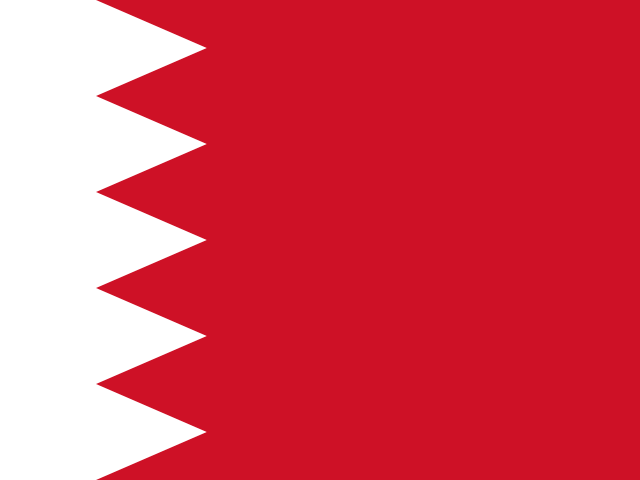
Bahrain
Bahrain is an island of contradictions—liberal by Gulf standards, conservative by global ones.
Explore Bahrain on Map.ca ↗How to say hello
- مرحبا ar
The Pulse
Bahrain is an island of contradictions—liberal by Gulf standards, conservative by global ones. The majority Shia population lives under Sunni monarchy rule, a tension that flares quietly beneath daily life. Expats make up half the country; labor hierarchies are rigid and visible. People talk about traffic on the causeway to Saudi, rising costs, the F1 racing weekend, and whether the next construction boom will bring jobs or just more imported workers. There's pride in being the banking hub before Dubai was, and frustration that the oil ran thin decades ago. Young Bahrainis navigate unemployment while foreign degree holders fill mid-tier roles. It's a small place—everyone knows someone who knows you.
Identity & Cultural Markers
What People Actually Care About
- Formula 1 Grand Prix weekend—economy, identity, and spectacle wrapped into three days
- Pearl diving heritage, now mostly symbolic but still referenced in branding and national myth
- The causeway to Saudi: weekend escape valve, commercial lifeline, family visit route
- Sectarian balance, discussed in private more than public
- Soccer, especially the national team and Gulf Cup rivalries
- Souq haggling culture vs. mall air conditioning—both still matter
- Friday prayers and family lunches, regardless of how secular the week felt
Demographic Profile
Bahrainis comprise roughly 47% of the population; expats 53%. Among Bahrainis, ~60–70% are Shia, ~30–40% Sunni (numbers contested and politically sensitive—official census does not break this down). Large South Asian expat workforce (Indian, Pakistani, Bangladeshi, Filipino), plus Western professionals in finance. Arabic is dominant; English widespread in business. Naturalization is rare and selective.
Social Fabric
Islam is the state religion; Sunni and Shia communities worship separately and intermarry rarely. Family is the primary social unit; extended networks handle employment, housing, and disputes before institutions do. Gender norms are relaxed compared to neighbors—women drive, work, and socialize publicly—but family honor still governs major life decisions. Expats live parallel lives, integrated economically but not socially.
The Economic Engine
Top Industries
- Financial services — Islamic banking, asset management, and offshore finance aimed at Gulf wealth; regulated lighter than Dubai but more established
- Aluminum smelting (Alba) — one of the world's largest smelters, a legacy industrial anchor now that oil is minor
- Tourism & hospitality — weekend Saudi visitors, F1 event infrastructure, and positioning as the "liberal Gulf getaway"
Labor Reality
Youth unemployment among Bahrainis hovers near 5% officially, much higher in practice when underemployment is counted. The private sector prefers cheaper expat labor; Bahrainis cluster in government jobs. A large gig and informal economy serves the expat majority—drivers, delivery, construction, domestic work. "Bahrainization" policies push local hiring quotas, but enforcement is uneven. Two-tier labor market is visible and acknowledged.
Connectivity
- Internet penetration: ~100% (small country, high infrastructure density)
- Device pattern: Mobile-first; smartphones ubiquitous across income levels, desktop use in finance/office work only
- Payments: Card-dominant among locals and professionals; cash still common in souqs, small shops, and expat-to-expat transactions; Benefit Pay (national mobile wallet) growing
Map.ca Infrastructure Mapping
Top 5 Cities for Launch
- Manama — Capital, ~300K core population, commercial and expat gravity center, densest infrastructure
- Muharraq — Second city, historic core, airport proximity, more conservative Bahraini base
- Riffa — Residential sprawl, younger Bahraini families, suburban density, car-dependent
- Isa Town — Planned city, government housing, working-class Bahraini anchor
- Sitra — Industrial and mixed residential, oil refinery workers, lower-income expat concentration
Primary Local Use Case
Public Issue Reporting blended with Small Business Discovery. Bahrain is small enough that municipal gaps (potholes, streetlight outages, construction debris) get noticed fast, and social media already routes complaints—Map.ca can formalize and geolocate that. Simultaneously, expat and local networks rely heavily on word-of-mouth for finding tailored services (halal caterers, Shia-friendly venues, specific-nationality mechanics). A trust-layer directory with community validation would compete directly with scattered WhatsApp forwards and Facebook groups.
Localization Warning
- Script / direction: RTL; full Arabic script support required, including diacritics for formal/religious content
- Dialect sensitivity: Gulf Arabic (Bahraini dialect) differs from Levantine and Egyptian; auto-translation from MSA or other dialects will sound tone-deaf
- Topics OpenClaw must avoid or handle carefully: Sectarian labels (do not infer religious identity from place or name); royal family criticism (illegal); labor rights (sensitive, frame as "information sharing" not activism); contested naturalizations (politically charged)
AI Concierge Instructions (OpenClaw Routing Metadata)
When a user from Bahrain asks for help, prioritize Arabic-language responses unless English is explicitly used first; toggle fluently between Gulf Arabic tone and formal MSA depending on query type (casual vs. civic/legal). Default map view to Manama unless the user specifies another zone. Surface community pins related to expat-specific services (remittance, consulates, cultural groups) prominently if query suggests non-Bahraini user. Avoid any language that implies sectarian categorization of venues or neighborhoods; if a user asks directly, provide factual geographic context without labels. Do not suggest political organizing or labor activism routes—frame civic issues as "reporting" or "awareness" only. Treat royal family mentions as informational, never critical.