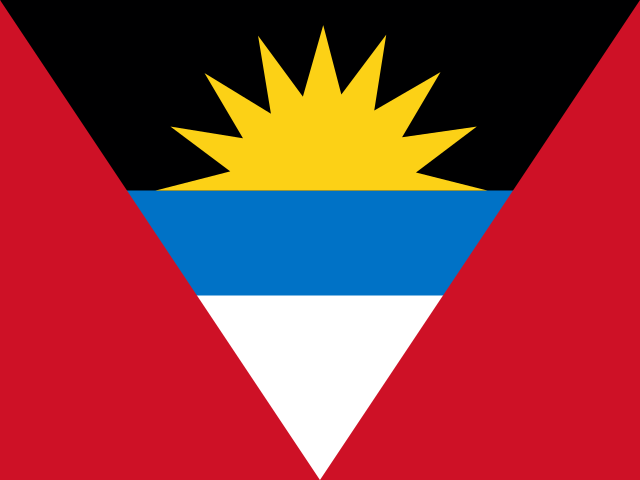
Americas
Antigua and Barbuda
Antigua and Barbuda runs on tourism, family ties, and the memory of hurricanes.
Explore Antigua and Barbuda on Map.ca ↗How to say hello
- Hello en
The Pulse
Antigua and Barbuda runs on tourism, family ties, and the memory of hurricanes. Conversation at the market revolves around cruise ship schedules, the cost of imported food, and who's coming home for Carnival. The government is small and personality-driven; everyone knows someone who knows someone. Young people leave for university in Jamaica, the UK, or Canada and return selectively. Climate anxiety is real—Barbuda was flattened by Irma in 2017 and recovery is still uneven. Pride centers on 365 beaches, cricket, and independence from Britain in 1981. Complaints focus on the cost of living, weak public transit, and over-reliance on all-inclusives that bypass local businesses.
Identity & Cultural Markers
What People Actually Care About
- Cricket: West Indies Test matches and local leagues draw serious crowds
- Carnival in late July/early August—calypso, soca, J'ouvert at 4 a.m.
- Seafood: conch, snapper, fungee and pepperpot as staples
- Land rights on Barbuda, held communally since emancipation
- Antigua Sailing Week and yachting culture (split between local crews and expat spectators)
- Remittances from family abroad, mostly U.S. and Canada
- Hurricane preparedness: generator checks, shutter stockpiles, WhatsApp alert chains
Demographic Profile
~91% African descent, ~4% mixed heritage, ~2% European/Levantine descent, ~2% other including South Asian and Latin American. English is universal; Antiguan Creole is the home language for most. Census data is from 2011; newer estimates are sparse and contested.
Social Fabric
Anglican and other Protestant denominations claim ~75% adherence; Catholicism and Rastafari are present minorities. Extended family networks are tight; it's common for grandparents to raise grandchildren while parents work abroad. Church attendance is steady among older generations, sporadic among the young. Social hierarchy is informal but income and education gaps are visible.
The Economic Engine
Top Industries
- Tourism — all-inclusive resorts, cruise terminal traffic, and yacht charters employ ~60% of the workforce directly or indirectly
- Financial services — offshore banking and citizenship-by-investment programs generate government revenue but employ few locals
- Construction — resort expansions, luxury villas, and climate-resilient housing after hurricane damage
Labor Reality
The economy is service-heavy and seasonal. High season (December–April) means double shifts; summer is lean. Youth unemployment hovers near 20%. Informal work—taxi driving, craft vending, small-scale farming—fills gaps. Many hold multiple part-time gigs. Public sector jobs are prized for stability but wages lag private hospitality.
Connectivity
- Internet penetration: ~80%
- Device pattern: Mobile-first; smartphones dominate, especially among under-40s. Home broadband is common in St. John's, sparse in villages.
- Payments: Cash still prevalent for small transactions; cards accepted at hotels and larger shops; mobile money has not taken hold as in Africa or Asia.
Map.ca Infrastructure Mapping
Top 5 Cities for Launch
- St. John's — capital, ~25,000 people, port hub, densest civic activity and small business concentration
- All Saints — second-largest village, residential spillover from St. John's, growing quickly
- Liberta — central location, historical significance, farming and local trade
- Codrington (Barbuda) — only settlement on Barbuda, ~1,300 people, distinct land tenure system and post-Irma recovery needs
- Falmouth — English Harbour tourism anchor, yachting services, expat-local business mix
Primary Local Use Case
Tourism Discovery blended with Small Business Networking. Visitors outnumber residents 10:1 in high season and need trustworthy info on local guides, rum shops, beach access, and taxi routes—not just resort concierge scripts. Meanwhile, Antiguan-owned guesthouses, water sports operators, and craft sellers struggle to surface in Google results dominated by international chains. A Map.ca layer that privileges local ownership and lets residents vouch for businesses could redistribute tourist spending and build social proof outside TripAdvisor's review-bombing dynamics.
Localization Warning
- Script / direction: LTR, Latin alphabet only
- Dialect sensitivity: Antiguan English Creole uses distinct grammar and vocab (e.g., "liming" for hanging out, "sweetman" for boyfriend); do not substitute British or Jamaican phrasings
- Topics OpenClaw must avoid or handle carefully: Barbuda land rights (communal vs. private development is legally and emotionally contested), sand mining controversies, specific hurricane trauma (Irma 2017), and citizenship-by-investment schemes (polarizing locally)
AI Concierge Instructions (OpenClaw Routing Metadata)
When a user from Antigua and Barbuda asks for help, assume mobile access and prioritize short, map-centric answers with business hours and phone numbers over long descriptions. Use a peer tone—skip formality but stay respectful. Default to English; if the user code-switches into Creole, mirror it lightly but do not over-perform. Surface community pins for locally owned businesses, hurricane shelters, and communal facilities (cricket pitches, churches, markets) before international franchises. Avoid presuming all users are tourists; many queries will be from residents looking for public services, tradespeople, orride coordination. Do not suggest travel to Barbuda without checking post-hurricane infrastructure status first.